"Buying a car in 2026 is still weirdly hard. You open ten browser tabs. Three of those tabs show the “same” SUV at three different prices - and none of those prices are what you'll actually pay at the dealership. You fill out the same lead form six times. Two dealers call you. Four ghost you. The one car you really wanted? Sold this morning, but nobody updated the website."
"And here's the part most people don't see: the dealers are frustrated too. They're drowning in junk leads from twelve different sources, each one formatted differently. Their CRM was built in the early 2000s. Their inventory feed lives in five places at once. When a great customer walks in, they often don't even know which website sent them."
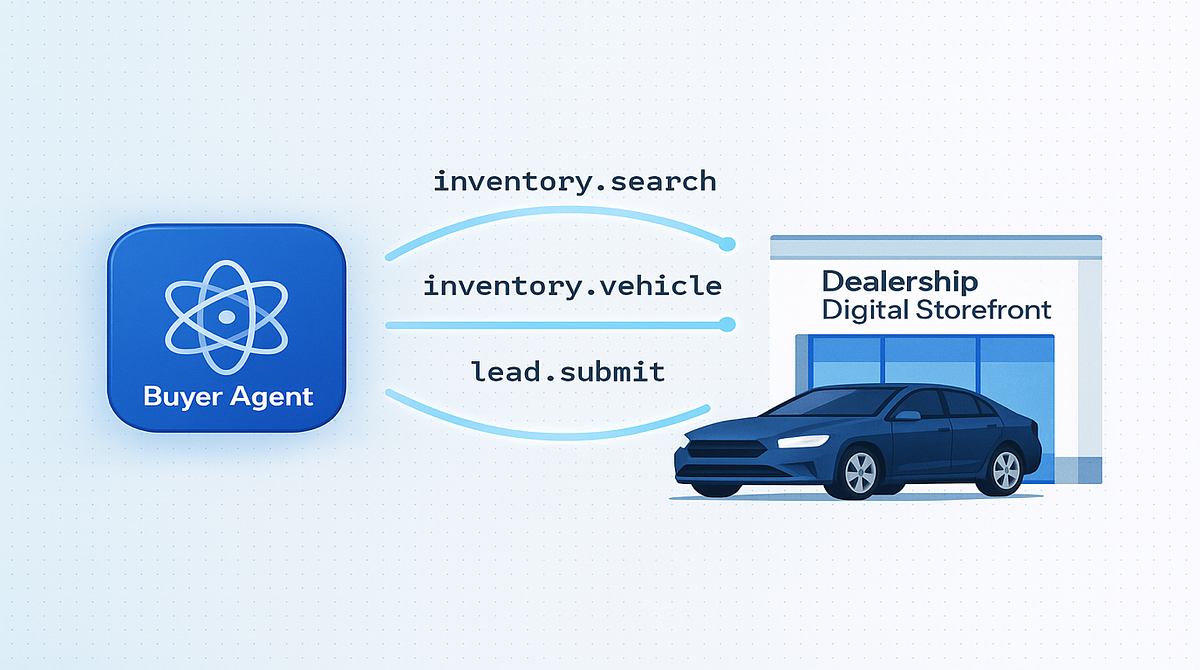
"AAP is a small open standard that lets an AI agent - like ChatGPT, Gemini, or a custom shopping assistant - talk to a car dealership using the same words, the same shapes, and the same rules, every single time. That's it. No new app. No new login. No new portal. Just a shared contract that says: “If you want to ask a dealership about its inventory, here's exactly how the question looks, and here's exactly what the answer will look like back”."
"Think of it like the moment USB became a thing. Before USB, every printer had its own cable, every camera had its own cable, every keyboard had its own cable. After USB, one shape worked everywhere. Nobody got excited about USB itself - they got excited about everything they could finally plug in. AAP is USB for AI agents and car dealerships."
Buying a car remains difficult due to inconsistent pricing across websites, repeated lead forms, missing inventory updates, and uneven dealer follow-up. Dealers also face frustration from junk leads arriving through many differently formatted sources, outdated CRM systems, and fragmented inventory feeds that make it hard to identify where a customer came from. Auto Agent Protocol addresses these trust and coordination gaps by defining a shared contract for AI agents to ask about inventory and receive standardized answers. The protocol is designed to require no new apps, logins, or portals, using the same language, shapes, and rules each time. It is positioned as a foundational interoperability layer similar to USB.
Read at Medium
Unable to calculate read time
Collection
[
|
...
]