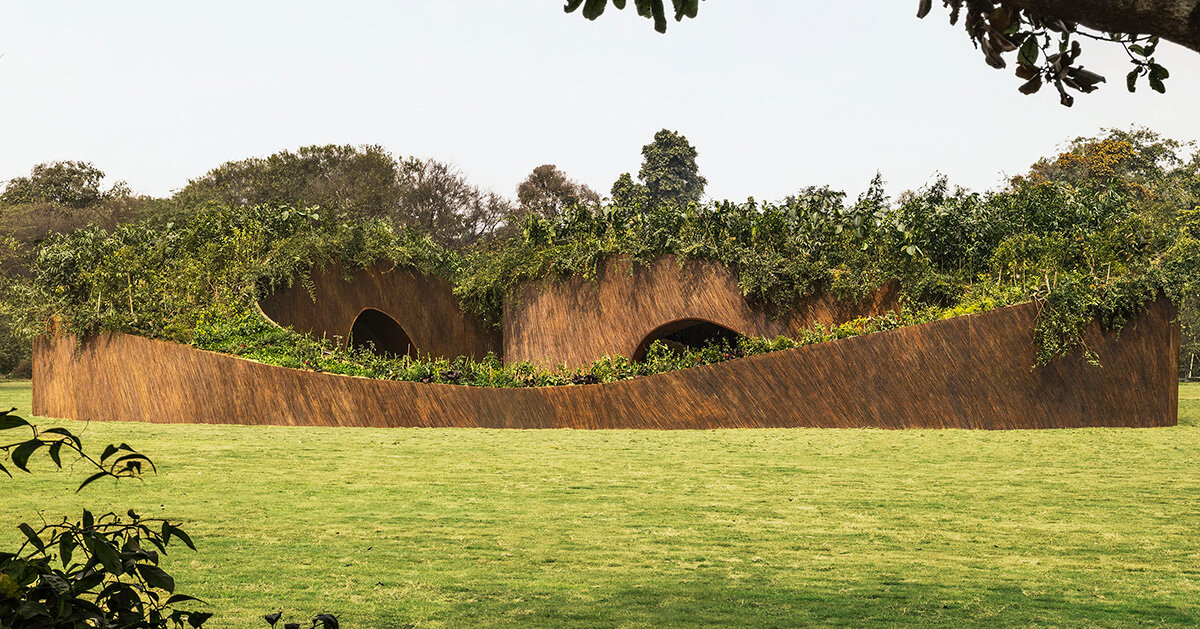
"Conceived as an annual architectural commission, the pavilion, designed in collaboration with T__M.space, marks the first time the conservation and creative initiative translates its ecological research into a built, walkable structure. 'The Aranyani Pavilion explores sacred growth through geometry and material. It emerges from a dialogue between digital design and physical craft, allowing the architecture to grow from its context rather than be imposed on it,' the architects tell designboom."
"The spiral structure is built from upcycled Lantana camara, an invasive shrub introduced to India through colonial trade routes in the eighteenth century. Now covering more than 13 million hectares and threatening large areas of forest, lantana is recast here as a structural lattice, fabricated by Ekarth Studio. Above it, a living canopy of more than forty native plant species, including edible, medicinal, and culturally significant varieties, forms a functioning microhabitat."
"Set within the historic landscape of Sunder Nursery, the pavilion by T__M.space takes the form of a spiral walkthrough installation. Its spatial logic draws from India's sacred groves, community-protected forest sanctuaries that functioned as early biodiversity reserves long before modern conservation law. As visitors follow a continuous, inward-moving path, the architecture modulates light, shadow, texture, and sound, echoing the layered rhythms of a living forest. The journey culminates in a central shrine anchored by a stone monolith,"
Aranyani presents Sacred Nature, a spiral architectural pavilion installed in Sunder Nursery, New Delhi, on view from February 4 to 20, 2026. The pavilion, commissioned as an annual architectural project and designed with T__M.space, translates ecological research into a built, walkable structure. The spiral lattice structure uses upcycled Lantana camara, an invasive shrub now covering more than 13 million hectares, repurposed and fabricated by Ekarth Studio. A living canopy of over forty native plant species, including edible, medicinal, and culturally significant varieties, forms a functioning microhabitat. The layout draws from India’s sacred groves, guiding visitors along a slow, inward-moving path that modulates light, shadow, texture, and sound and culminates in a central shrine anchored by a stone monolith.
Read at designboom | architecture & design magazine
Unable to calculate read time
Collection
[
|
...
]