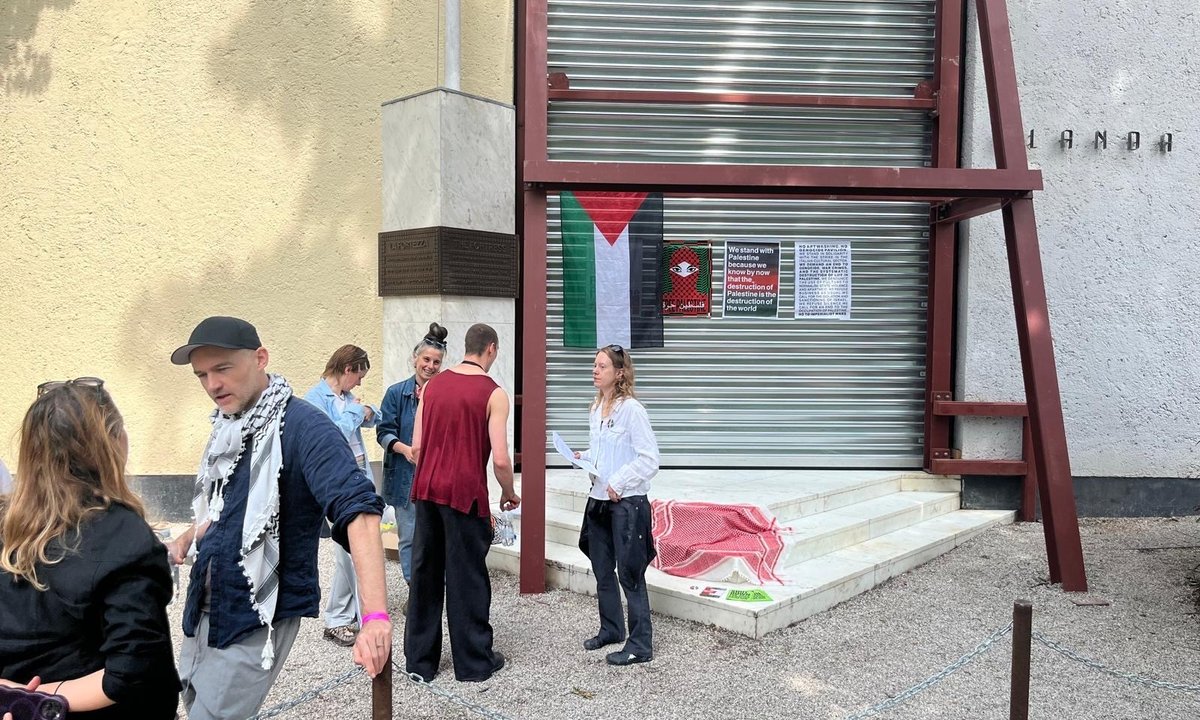
"A swathe of countries taking part in the Venice Biennale closed their pavilions today (8 May) as part of a strike in protest against Israel's participation in the event. The action, organised by the Art Not Genocide Alliance group (ANGA), "rejects both the normalisation of Israel's presence in cultural spaces and the economies of genocide in culture, while also denouncing the ecosystem of precarious labour that grows around the Biennale event," according to an ANGA statement. Around 18 pavilions have been taking part in full or partial closures, including Austria, Lebanon, Slovenia and Egypt."
"Dries Verhoeven, the artist representing the Netherlands this year, was stood outside his country's pavilion this morning, a Palestinian flag and materials relating to the protest hanging on the shuttered door behind him. "We think it's very undesirable that Israel has been given the chance to art-wash themselves with a pavilion in the Arsenale [one of the Biennale's two main venues], and we want to make that clear," he tells The Art Newspaper. "We are very happy to be here, to show our work for all the other days, but we see ourselves a bit as a horse of Troy. We want to discuss the event from the inside out and also to talk to the audience and to tell the audience, please don't accept this.""
"Verhoeven points to the fact that South Africa was barred from participating at the Biennale from the late 1960s to 1993, as a response to its apartheid regime. "I think the way artists and curators and art organisations manifested themselves back then, we should take that as an example." Another country taking part in the strike action is Poland, which will be closed from 4-7pm. Agniescka Pindera, the pavilion's commissioner, says the curators and the two artists spearheading the project "were deeply affected" by the decision to include Israel and Russia among the"
A group of countries participating in the Venice Biennale closed their pavilions on 8 May as part of a strike protesting Israel’s participation. The action was organized by the Art Not Genocide Alliance and rejected the normalization of Israel’s presence in cultural spaces and the economies of genocide in culture. It also denounced the precarious labor ecosystem that grows around the Biennale. About 18 pavilions were involved in full or partial closures, including Austria, Lebanon, Slovenia, and Egypt. The strike involved 237 curators, artists, and art workers. The Netherlands’ artist Dries Verhoeven stood outside the pavilion with a Palestinian flag and protest materials, describing the pavilion as a form of art-washing and urging audiences not to accept it. He compared the situation to South Africa’s exclusion during apartheid.
Read at The Art Newspaper - International art news and events
Unable to calculate read time
Collection
[
|
...
]