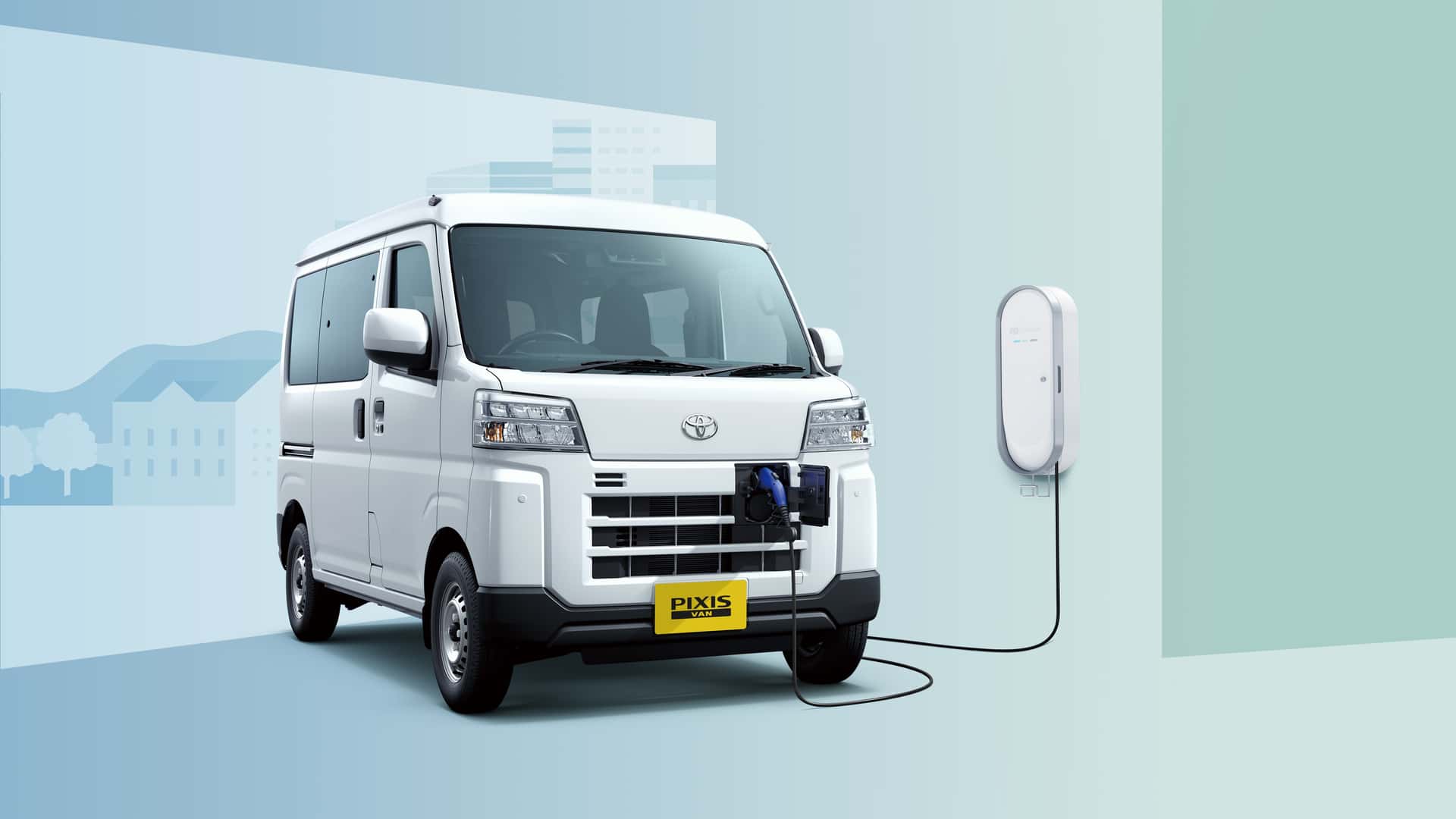
"That's because the e-Hijet's electric architecture has vehicle-to-load (V2L) and vehicle-to-home (V2H) functionality baked in. On the V2H front, the tiny EV's front-mounted CHAdeMO fast charging port can be used to keep the lights on, but additional hardware is needed. On the V2L front, however, things are much simpler. There's a 100-volt household outlet right on the center console, which can output a maximum of 1,500 watts, according to Daihatsu and Toyota."
"The new Daihatsu e-Hijet Cargo and fancier e-Atrai RS are powered by a new electric powertrain that was developed with the help of Suzuki and Toyota. In fact, Toyota has its own version of the new electric kei van, called the Pixis Van BEV, which is built by Daihatsu at its Nakatsu factory in Japan's Oita prefecture. That's not exactly a surprise, though, seeing how Toyota owns Daihatsu."
Daihatsu introduced the e-Hijet Cargo and e-Atrai RS, its first mass-produced electric models, developed with Suzuki and Toyota. Toyota sells a sister model, the Pixis Van BEV, built by Daihatsu in Nakatsu, Oita prefecture. The vans use lithium iron phosphate (LFP) batteries and support vehicle-to-load (V2L) and vehicle-to-home (V2H) functions. The front CHAdeMO fast-charging port enables V2H with additional hardware. A 100-volt household outlet in the center console provides up to 1,500 watts for V2L. A plastic accessory fits atop the driver-side window to allow plugged-in tools to remain outside while keeping the interior dry.
Read at insideevs.com
Unable to calculate read time
Collection
[
|
...
]