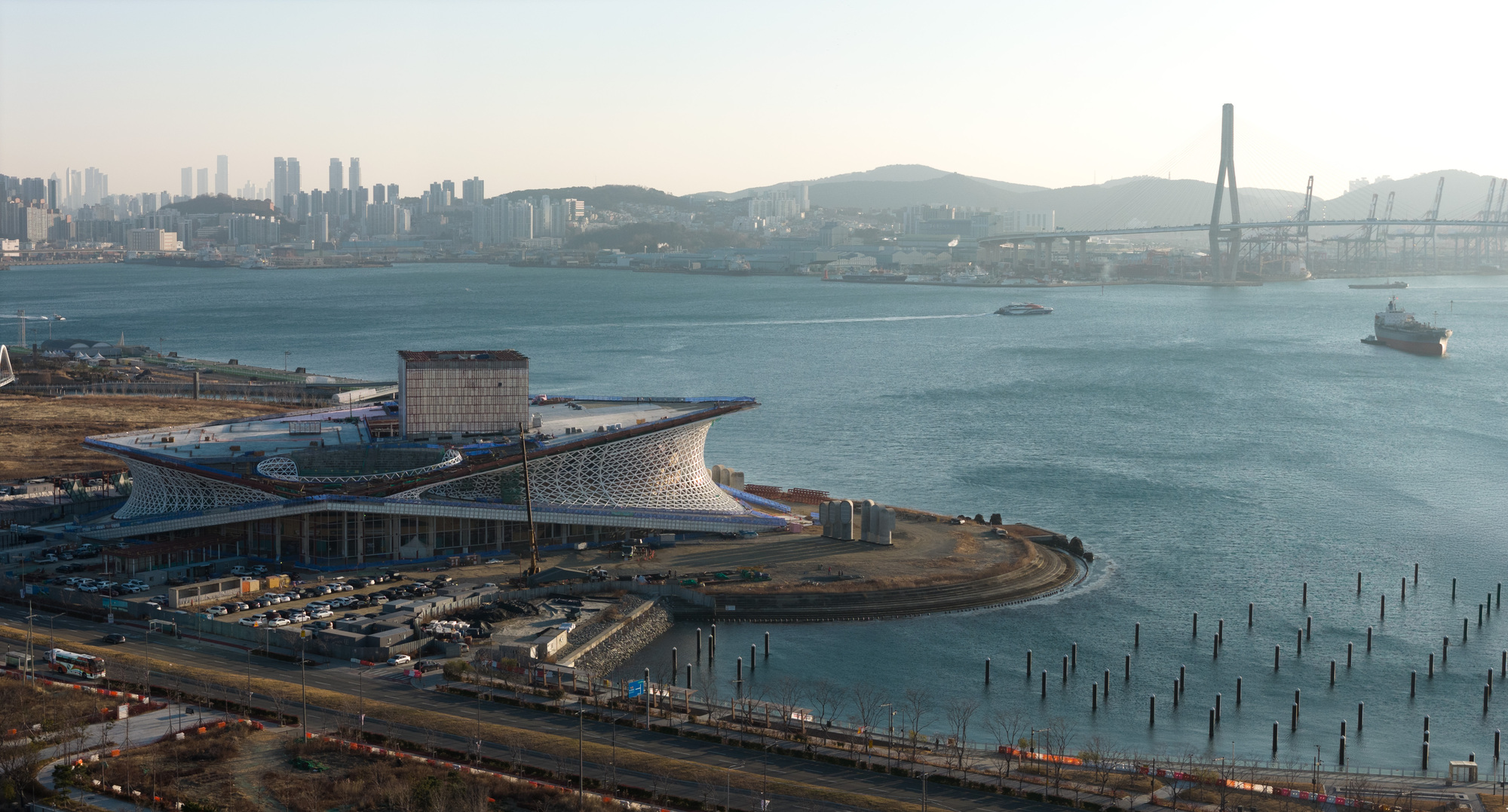
"Commissioned in 2012 following an international design competition, Snøhetta's Busan Opera House is under construction on the city's North Port waterfront, with major works scheduled for completion in late 2026 and an opening planned for 2027. Conceived as the first opera house in South Korea's second-largest city, the project redefines the traditional opera house as an open and inclusive civic institution."
"Situated on reclaimed land, the opera house plays a key role in transforming a formerly industrial waterfront into an accessible public realm. The 48,000-square-meter building integrates performance spaces with plazas, promenades, and a publicly accessible rooftop, reinforcing connections between the city, the park, and the sea. Programmatically, it includes a 1,800-seat main auditorium, a 300-seat multipurpose theater, rehearsal facilities, and public amenities."
"The architectural concept is defined by two opposing, continuous surfaces that shape the building's geometry. A lower, arching plane anchors the structure to the ground, bridging the city and the sea, while an upper plane opens upward toward the sky. The opera house is formed within the tension between these two elements, where land and water converge. The building's four corners extend toward the harbor, visually reinforcing its maritime context, while two diagonally lifted corners mark the main public entrances"
Snøhetta's Busan Opera House is under construction on reclaimed North Port waterfront land with major works due in late 2026 and an opening planned for 2027. The project functions as Busan's first opera house and as an open, inclusive civic institution supporting everyday use, collective experience, and long-term cultural engagement. The 48,000-square-meter complex integrates a 1,800-seat main auditorium, a 300-seat multipurpose theater, rehearsal facilities, plazas, promenades, and a publicly accessible rooftop. Multiple entrances from the urban side and the waterfront establish continuous civic presence, while two opposing continuous surfaces and lifted corners shape circulation and maritime connection.
Read at ArchDaily
Unable to calculate read time
Collection
[
|
...
]