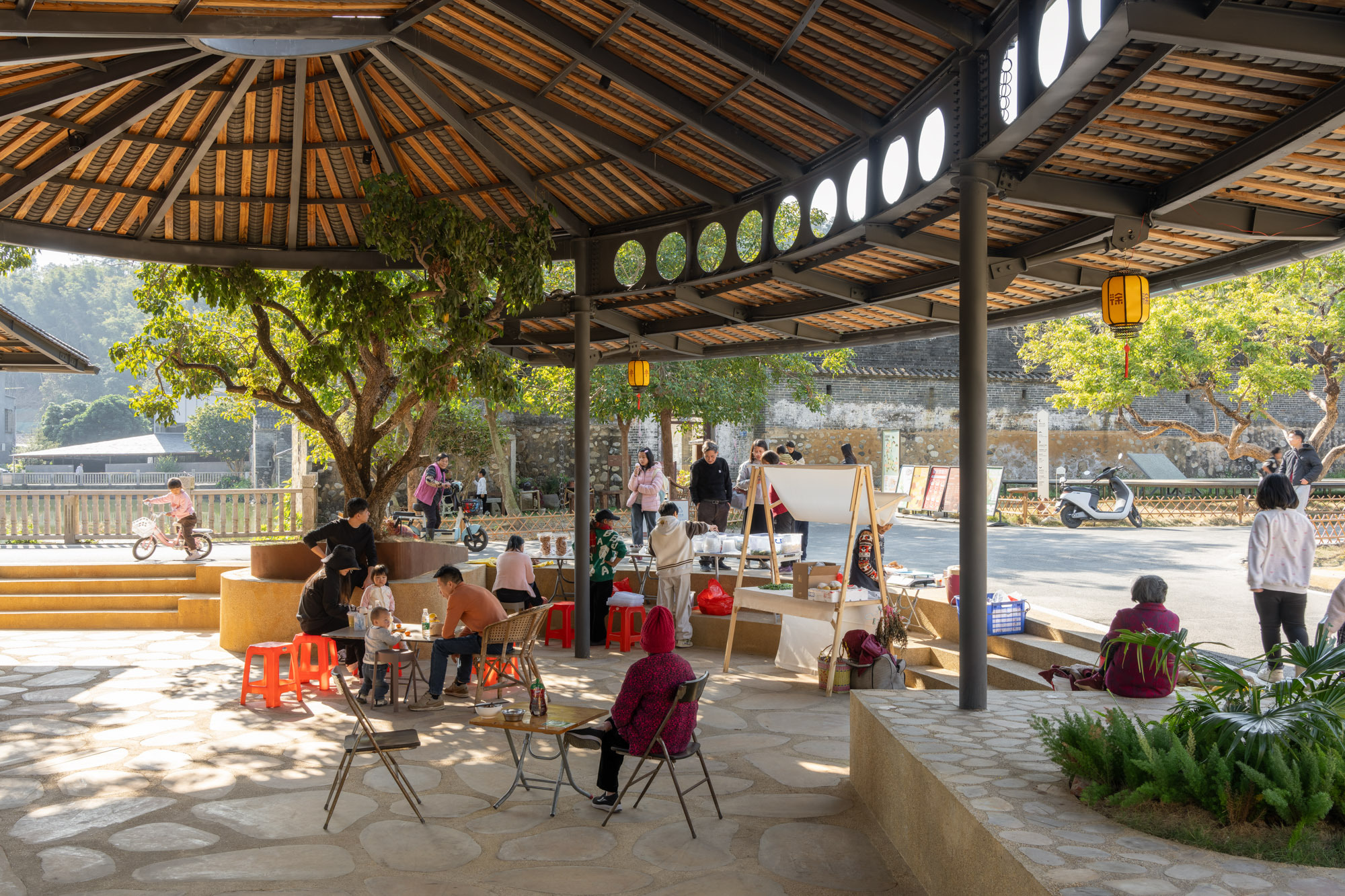
"At the foothills of Luofu Mountain, numerous streams formed, with one flowing southwest toward the plains, irrigating the farmlands.The early settlers gathered and settled against the hills, facing the stream, and ancient structures such as Wujingkui and Side Hall still remain today. From the area along Wujingkui and the fengshui-pond, the main peak of Luofu Mountain is visible. Following the launch of the Nankunshan-Luofushan Rim Pioneer Zone Architectural Art Project , Xutian Village was selected as our site due to its typical characteristics."
"It is carved out of the disparate leftover spaces behind the houses of 14 villagers. These spaces are linked along the fengshui-pond to form a continuous, narrow belt over 120 meters long and about 1,000 square meters in area. While sequentially connected, each of these 14 plots exists in its own unique state,currently filled with temporary sheds and toilets built by the villagers."
At the foothills of Luofu Mountain, numerous streams formed, with one flowing southwest toward the plains and irrigating farmlands. Early settlers gathered along the hills facing the stream, and ancient structures such as Wujingkui and Side Hall remain. From Wujingkui and the fengshui-pond the main peak of Luofu Mountain is visible. Xutian Village was chosen for the Nankunshan-Luofushan Rim Pioneer Zone Architectural Art Project because of its representative characteristics. The site is carved from disparate leftover spaces behind 14 houses, linked along the fengshui-pond to form a continuous narrow belt approximately 120 meters long and 1,000 square meters in area. Each plot retains unique conditions and is currently occupied by temporary sheds and toilets.
Read at ArchDaily
Unable to calculate read time
Collection
[
|
...
]