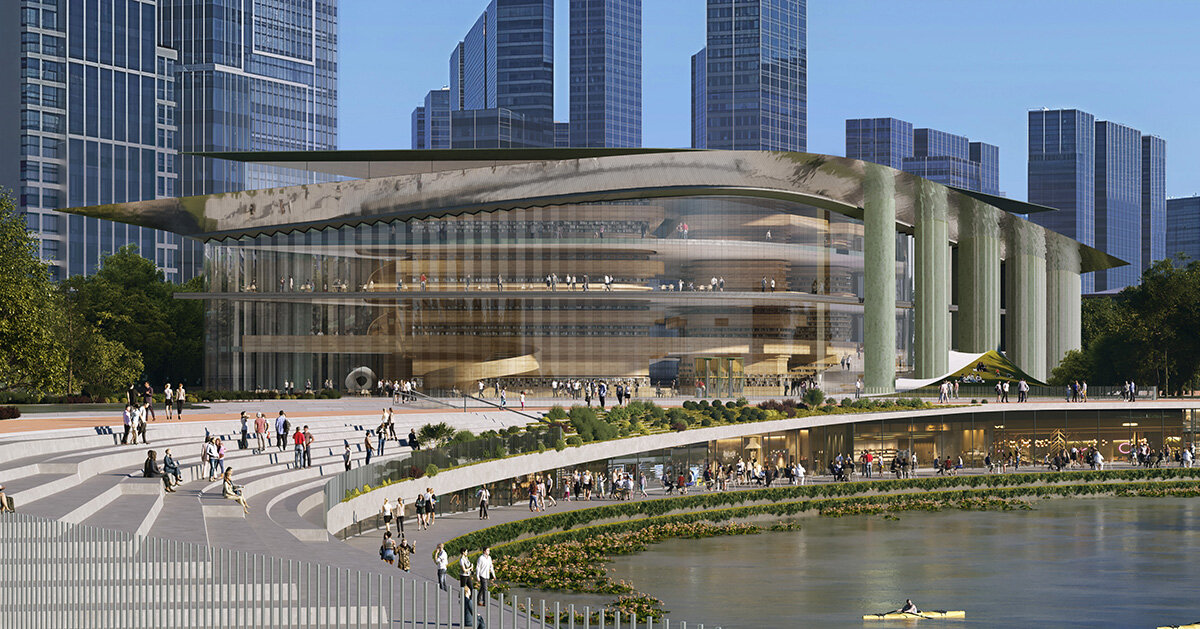
"Conceived as a green corridor threading through the city, the Central Water Axis reorganizes the canal basin into a sequence of landscaped terraces and waterfront promenades. New bridges and pedestrian paths stitch together both sides of the canal, reconnecting surrounding neighborhoods to the water while establishing a network of plazas and performance spaces designed for everyday use as well as large gatherings."
"Within this setting, ZHA's library proposal becomes both an architectural and symbolic anchor. Its structure is organized around a series of inhabitable columns that function simultaneously as load-bearing elements and spatial containers. The team conceived these columns as assembled 'stones of knowledge,' housing book collections, archives, reading rooms, and community spaces, while allowing the structural logic of the building to directly express its civic role."
Qiantang Bay Cultural District transforms former industrial land along the Zhedong Canal into a continuous landscape of parks, gardens, and civic spaces anchored by the Qiantang Bay Central Water Axis. The Central Water Axis reorganizes the canal basin into landscaped terraces, waterfront promenades, and connected plazas. New bridges and pedestrian paths reconnect neighborhoods to the water and create a network of performance and everyday gathering spaces. Cultural and educational buildings line the axis with orientations guided by views, circulation, and seasonal solar exposure. Zaha Hadid Architects' library is organized around inhabitable, load-bearing columns that house collections, reading rooms, and community spaces. The library's materials reference local jade craftsmanship through masonry tiles and folded glass that diffuse daylight.
Read at designboom | architecture & design magazine
Unable to calculate read time
Collection
[
|
...
]