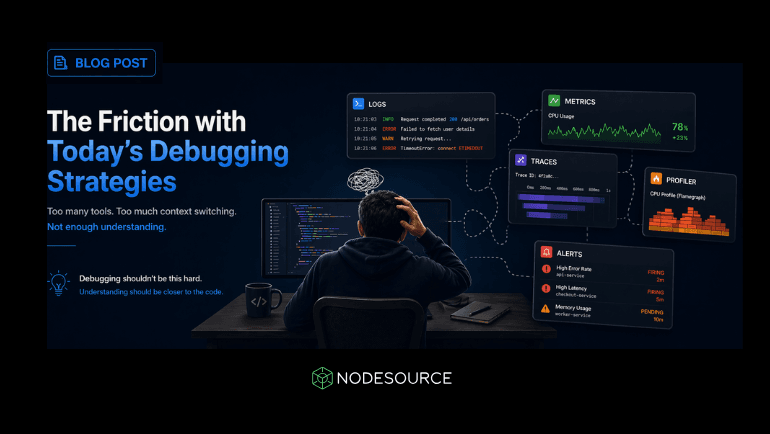
"One of the biggest issues today is not lack of data - it's lack of connected context. A typical debugging workflow looks like this: Each of these lives in a different tool. You're constantly switching between dashboards, trying to reconstruct what happened."
"Most observability platforms were designed for system health, not for understanding code behavior. They answer: But developers need: Which function caused this? What changed in the execution path?"
"Node.js is built around asynchronous execution. That's what makes it scalable - but also harder to debug. You're dealing with lost execution context across async boundaries, non-linear call stacks, timing-related issues, and event loop behavior under load."
"Most debugging workflows start after something breaks: This is inherently reactive. The challenge: You often don't have the right data when you need it."
Debugging in modern systems faces significant challenges due to fragmentation. Context is often scattered across various tools, making it difficult for developers to piece together information. Observability platforms focus on system health rather than code behavior, leaving developers without crucial insights. Asynchronous systems add complexity, leading to lost execution context and timing issues. Additionally, most debugging occurs reactively after failures, resulting in a lack of timely data. These factors contribute to the perception that debugging is harder than it should be.
Read at The NodeSource Blog - Node.js Tutorials, Guides, and Updates
Unable to calculate read time
Collection
[
|
...
]