"Electrocaloric effects are typically observed near and above room temperature because most ferroelectrics have relatively high Curie temperatures. However, cooling through room temperature remains elusive, despite its importance for various applications."
"Existing material systems cannot be exploited for cooling through room temperature. Sub-room-temperature electrocaloric effects have been reported, but they are small and thermodynamically impossible to use for effective cooling."
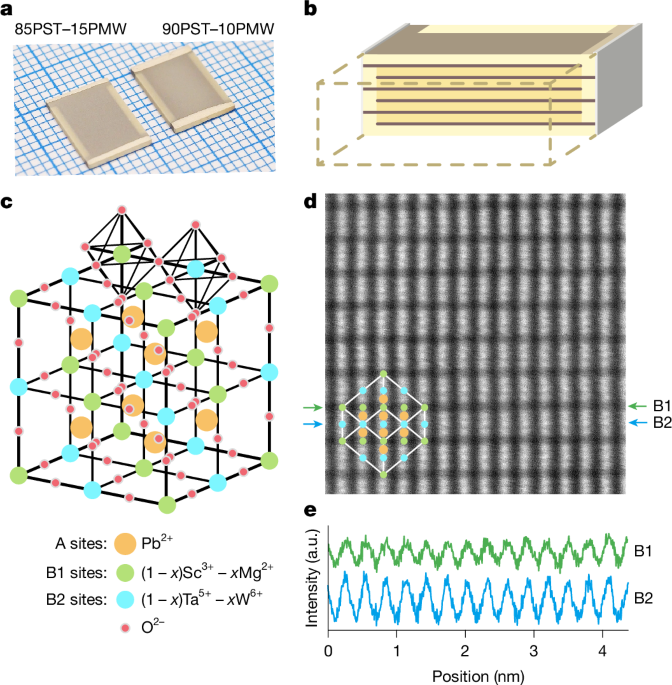
"Large-active-volume unannealed multilayer capacitors based on solid solutions of (1 − x)PST-xPMW show potential for significant electrocaloric effects, as PMW disruption of PST dipolar order suppresses the Curie temperature without compromising B-site order."
Electrocaloric effects arise from ferroelectric phase transitions driven by electric fields above the Curie temperature. These effects are significant in thin layers and multilayer capacitors, enabling cooling near room temperature. However, existing materials cannot achieve cooling through room temperature, which is crucial for various applications. Recent developments in unannealed multilayer capacitors based on solid solutions of PST and PMW show promise, as they maintain large latent heat during phase transitions, potentially leading to larger electrocaloric effects across a broader operational range.
#electrocaloric-effects #ferroelectric-materials #cooling-technology #phase-transitions #multilayer-capacitors
Read at Nature
Unable to calculate read time
Collection
[
|
...
]