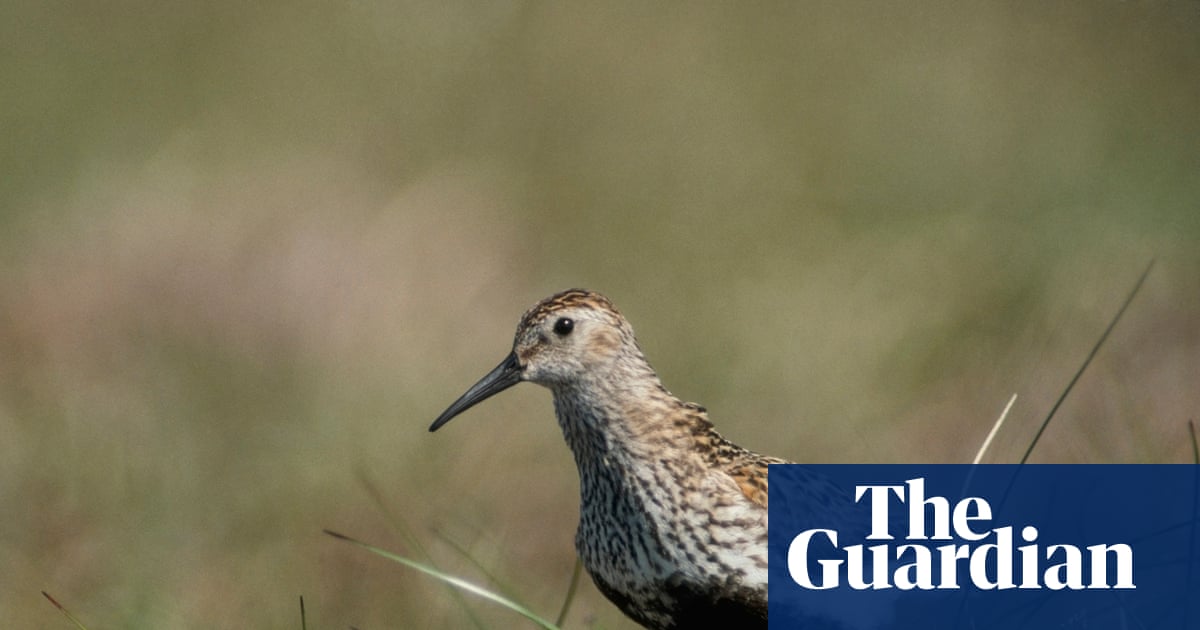
"Deep in the Cumbrian Pennines, walkers might be lucky enough to spot small birds with spindly legs, long beaks and bodies like feathered balls hopping through the peat bogs. These are endangered dunlins at risk in England because their favoured soggy landscapes are drained and burned for farming and grouse shooting. These birds fly an astonishing distance to breed in the far reaches of the heather moorlands in Cumbria, travelling thousands of miles to and from west Africa."
"A team from bird conservation charity the RSPB used drones to survey the hard-to-reach areas of the Pennines in the first survey of its kind, which was funded by Natural England. They were delighted to find tiny chicks, including on the High Helbeck estate where the landowners have been creating habitat for the birds to thrive in. The estate managers have created 79 hectares of peatland restoration and 25 new wader scrapes, which are the shallow pools the birds pick through to find food."
Endangered dunlin breed on heather moorlands in Cumbria after migrating thousands of miles from west Africa. Favoured soggy peatland habitats have been drained and burned for farming and grouse shooting, contributing to declines. An RSPB drone survey, funded by Natural England, found tiny chicks in hard-to-reach Pennine areas. High Helbeck estate created 79 hectares of peatland restoration and 25 wader scrapes, producing feeding sites where chicks were observed. Dunlin populations have fallen at least 20% globally since the early 2000s and are classified near threatened by the IUCN and red-listed in the UK. Conservationists cite climate change and habitat degradation as key threats.
Read at www.theguardian.com
Unable to calculate read time
Collection
[
|
...
]