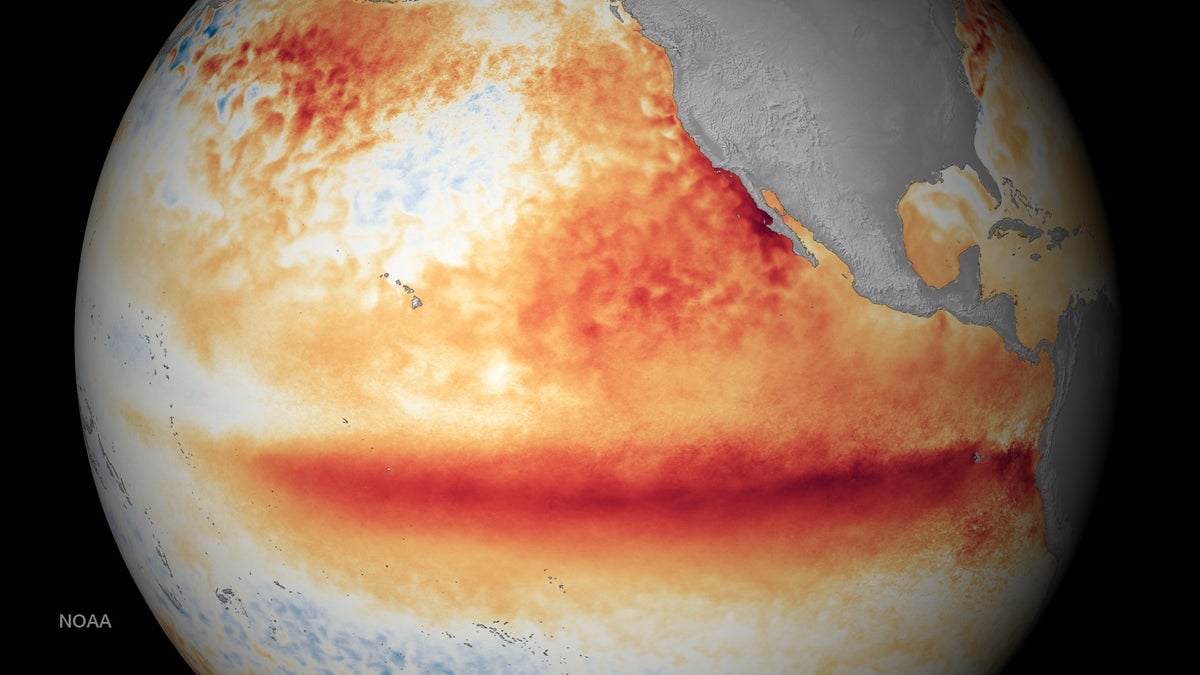
"During El Nino events, warm ocean water moves from the western Pacific toward North and South America. The changes in ocean temperatures can set off a string of weather impacts across the globefor instance, it can mean heavy rains in the southern US, while regions on the other side of the Pacific tend to dry out."
"According to the WMO, chances of El Nino are around 40 percent between May and July this year. The predictions are preliminary and could change. Predicting whether this will be an El Nino year so far in advance is tricky, in part because global climate patters are complicated, and because it's still early."
"The National Oceanic and Atmospheric Administration (NOAA) currently puts the chances of an El Nino forming at about 50 to 60 percent for the late summer, although those predictions are also subject to change."
El Niño, a climate pattern driven by Pacific Ocean temperature and wind changes, caused significant global impacts two years ago, including heavy rainfall in the western U.S., drought in Southeast Asia, and record temperatures. The phenomenon occurs when warm ocean water moves from the western Pacific toward the Americas, triggering widespread weather effects. Its counterpart, La Niña, produces opposite conditions with cold, wet weather in the northern U.S. and increased rainfall in Asia and Australia. The World Meteorological Organization announced a moderate 40 percent chance of El Niño returning between May and July 2026, while NOAA estimates 50-60 percent probability for late summer. Both predictions remain preliminary and subject to change due to the complexity of global climate patterns.
Read at www.scientificamerican.com
Unable to calculate read time
Collection
[
|
...
]