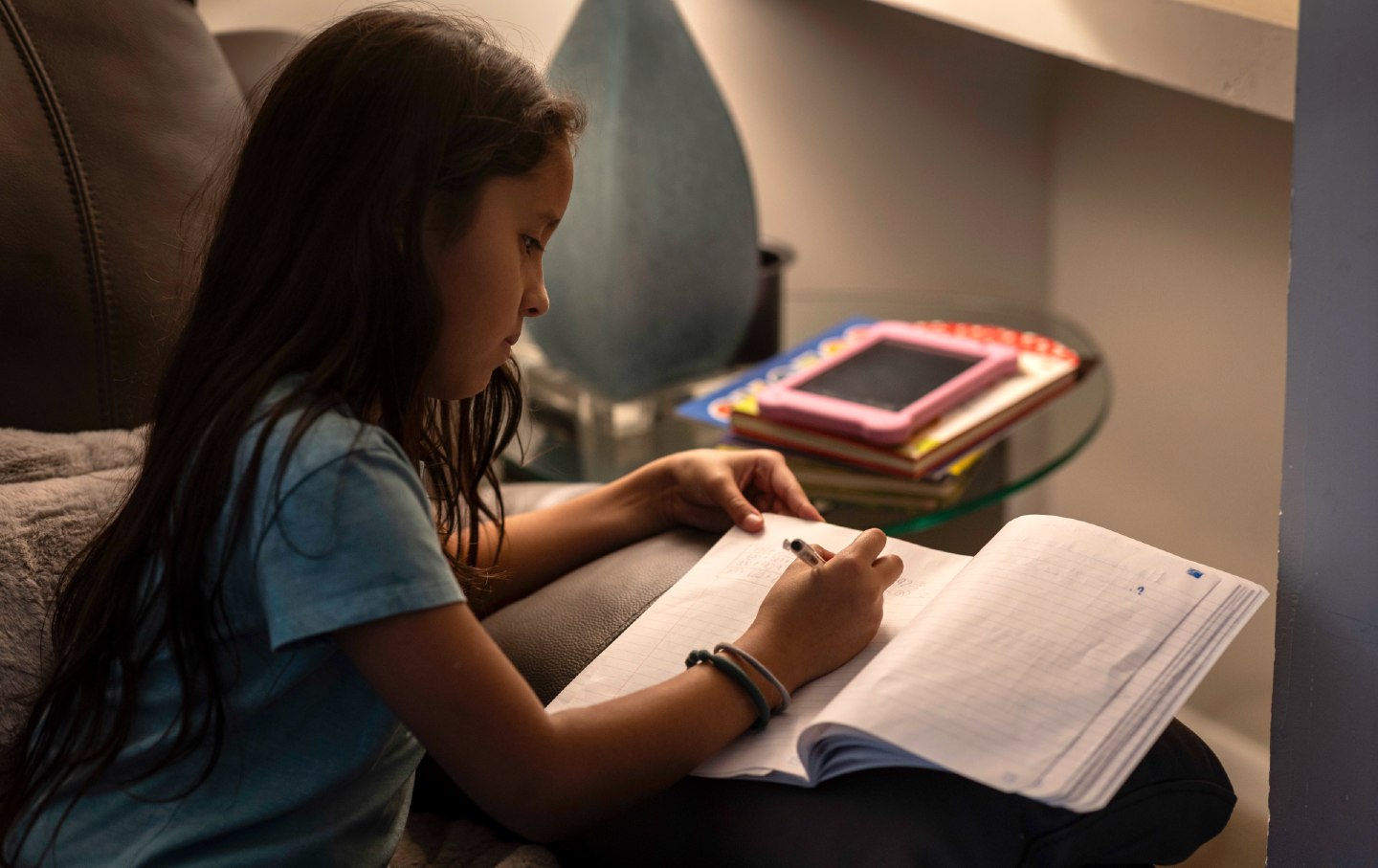
"“They're not the same as before they left,” said Lina, a teacher at a mostly Spanish-speaking public school near the southern border in El Paso. According to Lina, who asked to be identified by her first name only due to privacy concerns, post-detention behavioral changes are not always dramatic. The subtle differences can appear in daily routine, in appetite, in the tempo of a child's speech. Of the older sister, Lina remarked, “she doesn't use color as much in her drawings.” Of the other, she observed distress when leftover snacks were thrown away: “She wanted to take extras or whatever was left and she didn't want me to throw anything away.”"
"Data analyzed by The Marshall Project shows that ICE has detained more than 6,200 children since the start of President Donald Trump's second term, with the daily number in custody rising to about 10 times the level recorded at the end of the Biden administration. For school staff, the fallout can take several forms: children returning after detention, students coping with a parent's deportation, and school communities reshaped by the fear of who might be taken next. There is a simmering sense of dread at schools coast to coast."
Family detention has increased nationwide, with ICE detaining thousands of children and daily custody rising sharply. After detention, children may return to school with subtle behavioral shifts rather than dramatic outbursts. Teachers and counselors describe changes in daily routine, appetite, and the pace of children’s speech. Some children draw with less color, while others show heightened distress when food or leftovers are discarded. School staff also face broader impacts, including students coping with a parent’s deportation and communities reshaped by fear of further removals. The result is a pervasive sense of dread across schools.
Read at The Nation
Unable to calculate read time
Collection
[
|
...
]