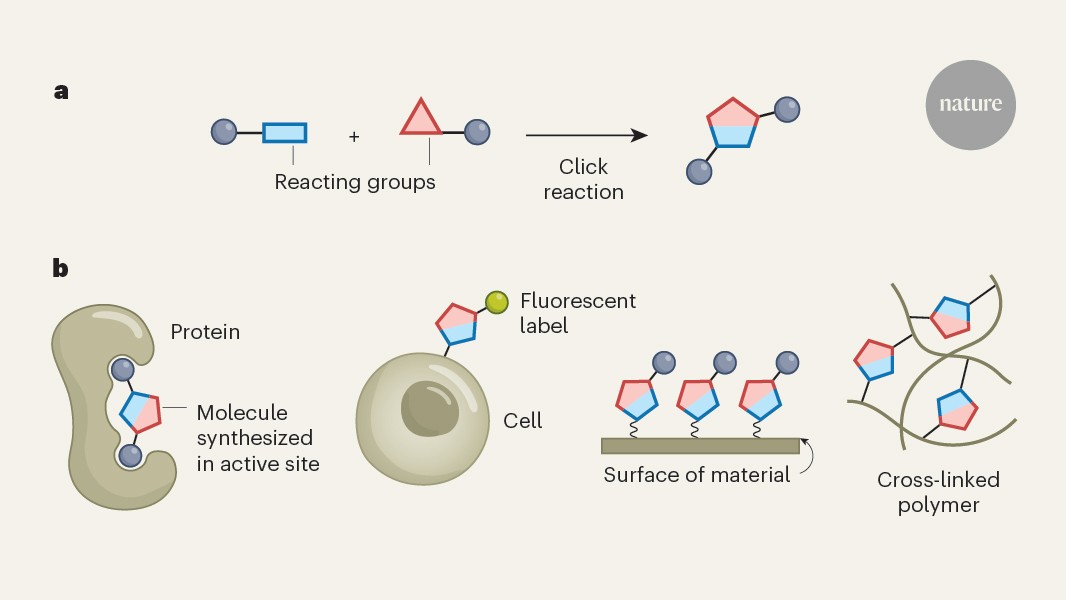
"In 2001, the chemists H. C. Kolb, M. G. Finn and K. Barry Sharpless published a review in Angewandte Chemie that revolutionized how molecules were used in several scientific fields."
"The paper launched the concept of click chemistry: a class of chemical reactions that work in solution exceptionally efficiently to 'click' together two or more molecules in a highly specific manner and without producing any unwanted by-products."
"Originally conceived of as a tool for synthesizing pharmaceutical candidates, click chemistry is now widely used by biologists and engineers, and won Sharpless a share of the 2022 Nobel Prize in Chemistry."
Click chemistry, introduced in 2001 by Kolb, Finn, and Sharpless, revolutionized molecular synthesis by allowing highly efficient reactions that connect molecules specifically. Initially aimed at pharmaceutical synthesis, its applications have expanded to biology and engineering. The method's effectiveness and specificity have garnered significant recognition, culminating in Sharpless receiving a share of the 2022 Nobel Prize in Chemistry. Click chemistry's ability to avoid unwanted by-products has made it a valuable tool across various scientific disciplines.
Read at Nature
Unable to calculate read time
Collection
[
|
...
]