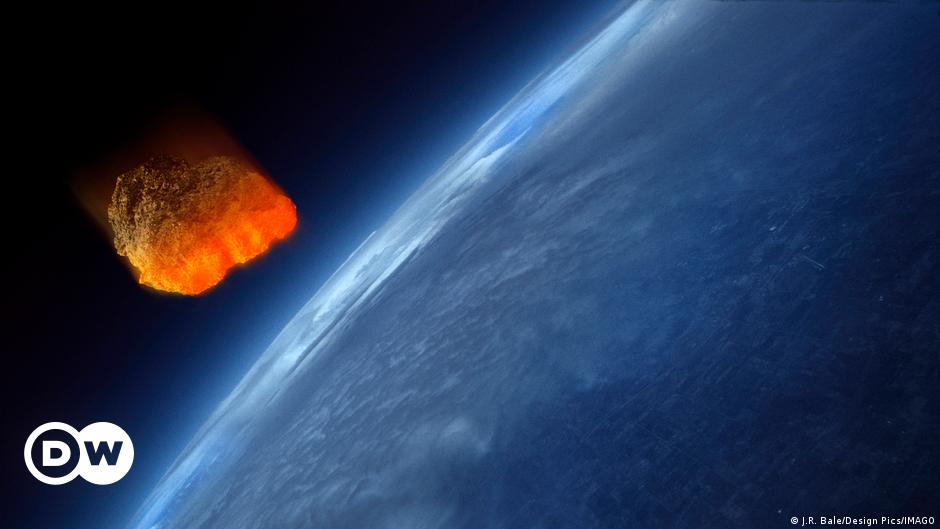
"“Publications need to have these 'cliffhangers' to have visits,” said Juan Luis Cano of the European Space Agency's Planetary Defense Office. “But on a daily basis we are visited by many objects.” In fact, around 100 tons of space material hits Earth every day. Fortunately, the mass is spread across many tiny rocks, rather than one, large destructor. Large destructors: near-Earth objects in a nutshell"
"The United Nations Office for Outer Space Affairs defines near-Earth objects (NEOs) simply as any asteroid or comet which passes close to Earth's orbit. In more technical terms, NEOs are objects with a perihelion their closest orbital distance to the sun of under 195 million kilometers. Given that Earth orbits the sun at a distance of about 150 million kilometers, NEOs are well within our solar neighborhood. Scientists like Cano know of about 34,000 NEOs, but none of the larger ones are currently on course to hit Earth."
"While tiny NEOs smack Earth every day, the larger ones hit far less often. Asteroids the size of 2024 ON might strike Earth once every 10,000 years. Those bigger than a kilometer in diameter, such as the Chicxulub asteroid that sent the dinosaurs into extinction 66 million years ago, might hit within the next 260 million years. “We estimate there are around one thousand objects larger than a kilometer and we have discovered 95%"
An asteroid such as 2026 JH2 can be detected and predicted to fly by Earth at a close distance, creating fear even when impact remains very unlikely. Scare stories often spread widely, even though many objects regularly enter Earth’s vicinity. Around 100 tons of space material reach Earth every day, mostly as many small rocks rather than a single large body. Near-Earth objects include asteroids or comets that pass close to Earth’s orbit, with perihelion distances under 195 million kilometers. Scientists estimate about 34,000 near-Earth objects, and none of the larger ones are currently on a collision course. Impacts become rarer as size increases, with kilometer-scale events occurring over hundreds of millions of years.
Read at www.dw.com
Unable to calculate read time
Collection
[
|
...
]