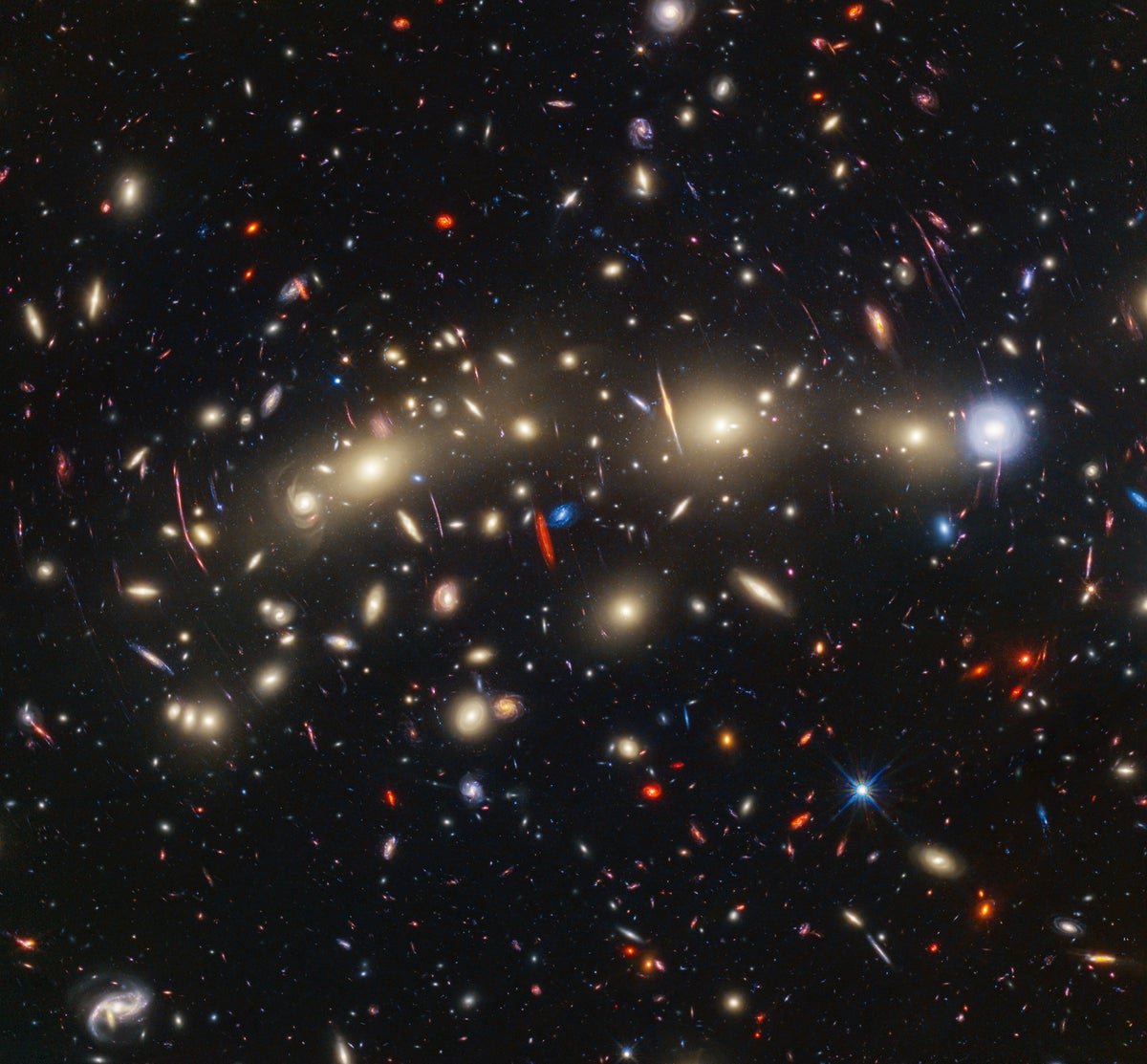
"Using humanity's biggest off-world observatory to focus on a tiny, faraway arc of light magnified by a quirk of spacetime, astronomers have glimpsed a faint galaxy as it was 13 billion years ago, when it was brimming with dark matteras well as what may be fresh ashes from the universe's earliest, strangest stars."
"The small, faraway galaxy is named LAP1-B, the observatory is NASA's James Webb Space Telescope (JWST), and the strange stars would have been members of what astronomers call Population IIItitanic suns that burned bright and died young close to the dawn of time."
"Such stars are the quarry that JWST was designed forstellar orbs composed of pristine, primordial hydrogen and helium gas that were summoned into being by the big bang. These stars are not quite the stuff that most cosmologists' dreams are made of but rather the sources for the atoms that made cosmologists themselves."
"The oxygen in your lungs, the iron in your blood, the calcium in your bones, the carbon in your cells, and even the silicon in your smartphone can all be traced back to Population III stars, which blasted out heavy-metal cosmic fertilizer (astronomers call all heavier-than-helium elements metals) upon their explosive deaths."
A distant, faint galaxy named LAP1-B was observed using NASA’s James Webb Space Telescope by focusing on a tiny arc of light magnified through a spacetime effect. The observation targets conditions from about 13 billion years ago, when the galaxy contained dark matter and possible remnants from the universe’s earliest, strangest stars. Those stars are identified as Population III, massive “titanic suns” made of primordial hydrogen and helium that formed near the dawn of time. Their explosive deaths produced heavy elements, described as metals, which later became the raw material for Population II and Population I stars, planets, and ultimately the elements found in living organisms and technology. Direct confirmation of Population III stars remains difficult because they are extremely far away in both space and time.
Read at www.scientificamerican.com
Unable to calculate read time
Collection
[
|
...
]