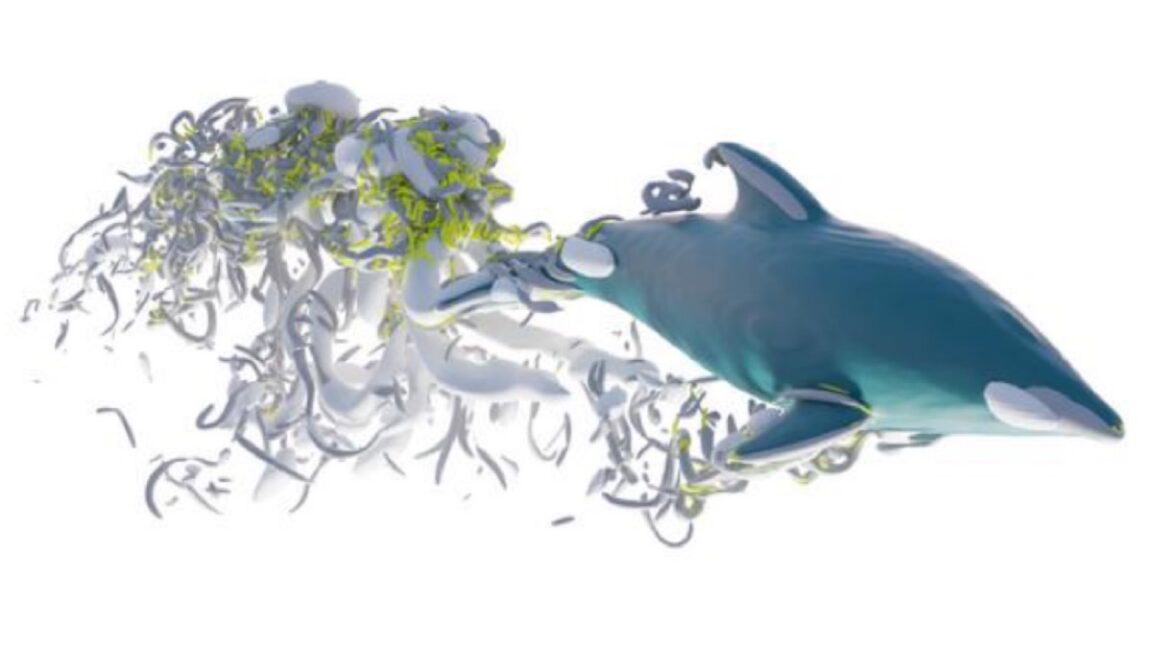
"Our results show that the hierarchy of vortices in turbulence is crucial for understanding dolphin swimming. The largest vortices are responsible for most of the propulsion, while the smaller ones are mainly byproducts of turbulent flow."
"The computer simulations enabled the team to break down those different sizes, revealing that the initial tail oscillations produce large vortex rings that generate thrust, and those larger ones then produce many more smaller vortices."
Dolphins achieve impressive swimming speed through the vortices produced by their tail movements. Research from the University of Osaka utilized supercomputer simulations to analyze dolphin propulsion. The study revealed that large vortex rings generated by tail oscillations are primarily responsible for thrust, while smaller vortices are secondary effects. Understanding these dynamics can inform the design of more efficient underwater robots. Other scientific stories include tracking Roman ship repairs and the discovery of mushrooms detecting human urine.
Read at Ars Technica
Unable to calculate read time
Collection
[
|
...
]