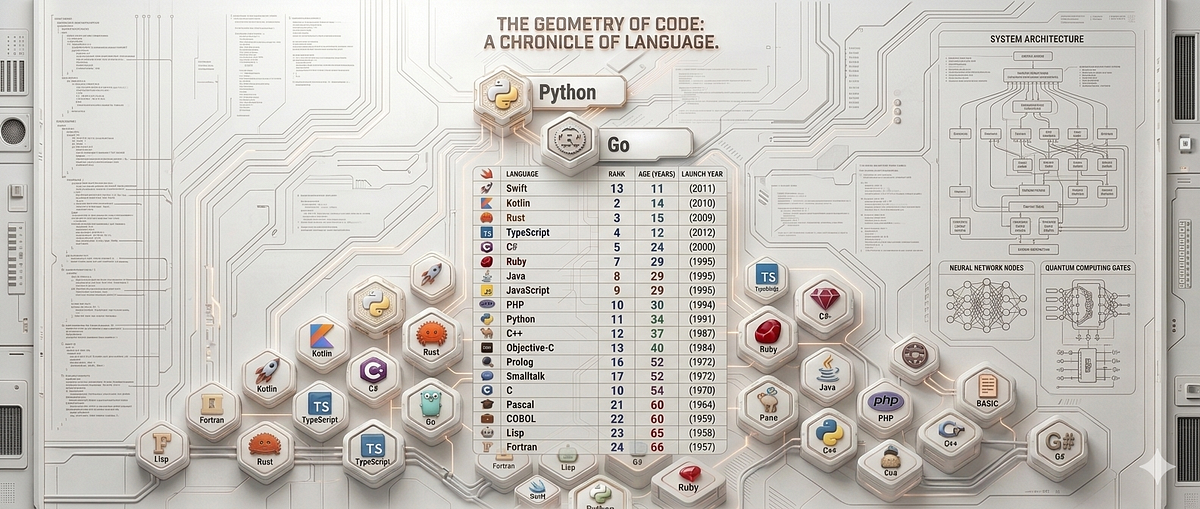
"Programming languages did not appear randomly , they evolved over time as developers faced new types of problems in software development. In the early days, programming was done using low-level languages like machine code and assembly, which were difficult to write and understand. As systems became more complex, new languages were created to simplify development, improve readability, and reduce human effort."
"Over the years, different types of programming languages emerged based on specific needs. Some languages like C were designed for system-level control and performance, while others like Java focused on portability across platforms. Later, languages like Python were introduced to improve developer productivity and simplify coding. Modern languages such as Go and Rust focus on scalability, concurrency, and safety in distributed systems."
"Understanding this evolution helps in identifying why a particular language exists and what problem it solves. Instead of just learning syntax, it becomes important to understand the purpose behind each language - whether it is designed for system programming, web development, mobile applications, or large-scale distributed systems."
"The main idea behind creating Python was to solve a very real problem that developers were facing at that time - programming languages like C and C++ were powerful, but they were complex, difficult to read, and required writing a lot of boilerplate code even for simple tasks. Guido wanted to create a language that feels natural to read and write, almost like English, so that developers can focus more on solving problems rather than struggling with syntax."
Programming languages emerged gradually as developers encountered new software problems. Early development relied on machine code and assembly, which were hard to write and understand. As software systems grew more complex, new languages were created to simplify development, improve readability, and reduce human effort. Different languages targeted different needs: C emphasized system-level control and performance, Java emphasized portability across platforms, and Python emphasized developer productivity and simpler coding. Modern languages such as Go and Rust focus on scalability, concurrency, and safety for distributed systems. Understanding why a language exists clarifies what problem it solves, including system programming, web development, mobile applications, or large-scale distributed systems. Python was created to reduce complexity and boilerplate while making code feel natural to read and write.
Read at Medium
Unable to calculate read time
Collection
[
|
...
]