"Nucleation refers to the early processes that initiate fault rupture, marking the transition from a stable, locked fault to an unstable, dynamically slipping one."
"The nucleation length, a critical measure of the size of the slipping zone before dynamic rupture, is primarily governed by the fracture energy of the fault interface and the weakening rate within the nucleation region."
"Some earthquakes seem to be preceded by a prolonged nucleation stage, potentially accompanied by foreshocks, whereas many others exhibit no detectable dynamic precursor activity at all."
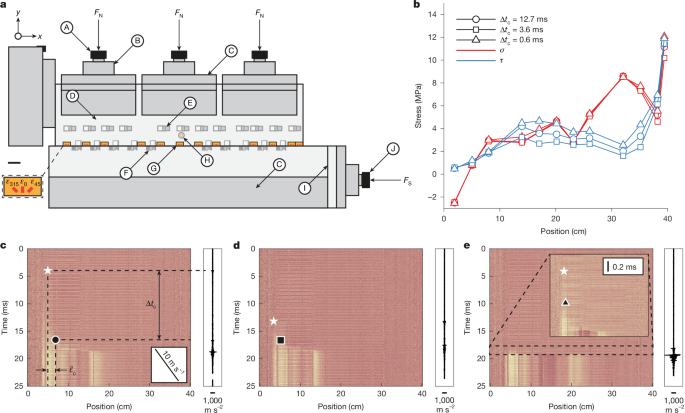
"Laboratory experiments directly capture how foreshocks control the nucleation of earthquakes, with a small initial slip event setting the transient sliding velocity."
Nucleation is the initial process that leads to fault rupture, transitioning from a stable to an unstable state. Coseismic rupture is preceded by quasi-static slip that grows until it triggers dynamic failure. The nucleation length is influenced by the fault interface's fracture energy and weakening rate. However, the conditions for detecting precursory signals remain unclear. Some earthquakes have prolonged nucleation stages with foreshocks, while others do not show detectable precursors, indicating a need for further research into the mechanisms governing nucleation.
Read at Nature
Unable to calculate read time
Collection
[
|
...
]