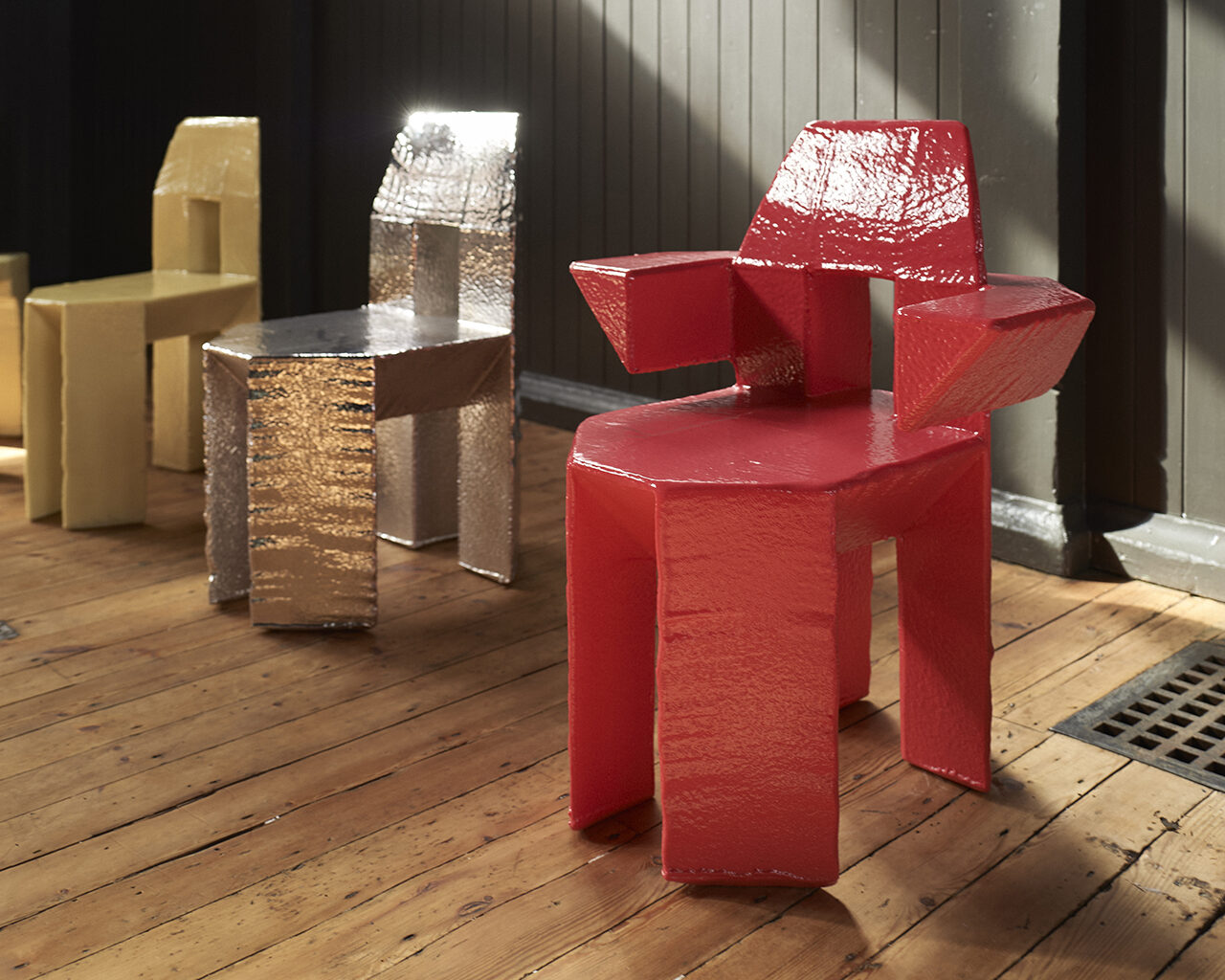
British designer Max Lamb challenges Modernist furniture conventions and mass-manufacturing economics by reinterpreting age-old craft methods. His approach uses fresh applications for salvaged parts and overlooked natural elements, requiring little processing or adulteration. The work often produces roughly hewn forms where seating function can be subtle, while other pieces clarify purpose through engineered assembly. The Economy Chair, now called the Min Chair, uses pinewood beams cut to precise angles and fitted into a bold, exacting structure. Serial production by Hem translates a self-build logic into a scalable model through trial and error, aiming for maximum character with minimal means and avoiding unnecessary decoration.
"For well over a decade, British designer Max Lamb has been challenging the code and conduct of a contemporary furniture industry still mired in Modernist convention and the bottom-line economic model of often-disjointed mass manufacturing. Defined by a reinterpretation and revitalization of age-old craft techniques, the provocateur has carved, sand-cast, molded, and folded an approach all his own: one predicated on finding fresh applications for salvaged components and those unexpected natural elements no one before him deemed suitable."
"For Lamb-like Augustus Pugin and the proponents of the Arts and Crafts movement-aesthetics, and perhaps also function, should always be the outcome of making and reflective of the inherent properties of the materials incorporated. This career-defining proposition is fundamentally sustainable. Little processing or adulteration is necessary."
"Put into serial production by innovative Swedish brand Hem-translating a self-build logic into a scalable model-the Min Chair is the result of intensive trial and error: research into attaining maximum character with minimal means. There's no extraneous energy exerted in systematically cutting and assembling the modular components, and so, in turn, no superfluous decorative detail is added. The design is unabashedly sculptural but also straightforward in ontologically self-communicating its purpose, deftly turning the Modernist tenet of form following function on its head."
#sustainable-design #craft-techniques #furniture-manufacturing #arts-and-crafts #modernism-vs-function
Read at Design Milk
Unable to calculate read time
Collection
[
|
...
]