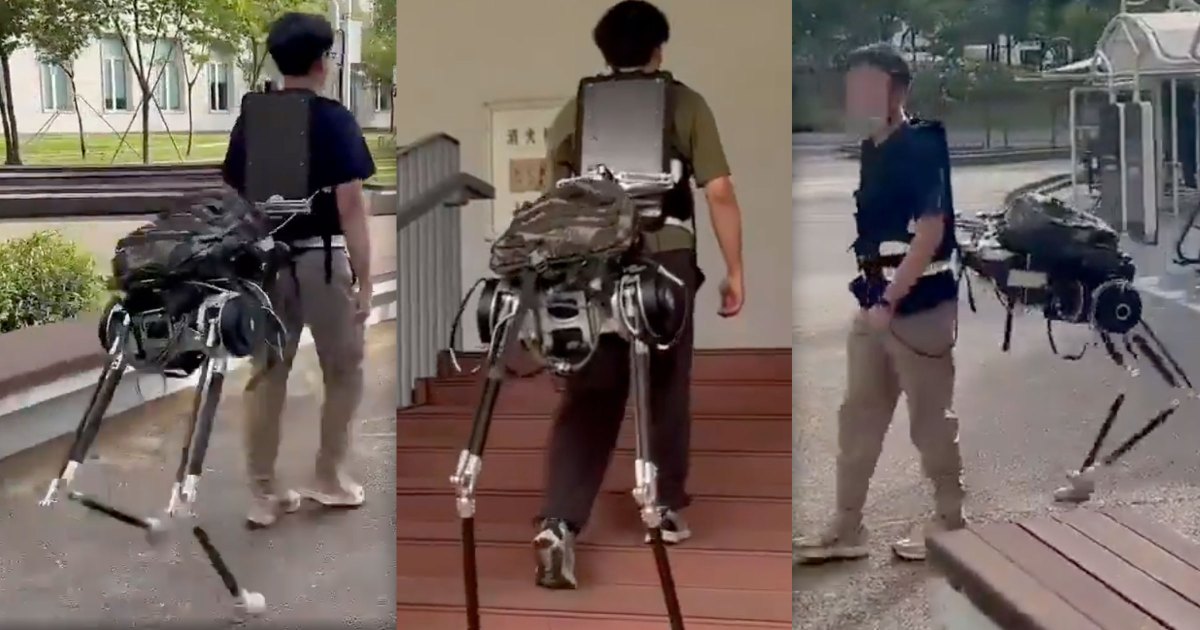
"Experimental evaluation results demonstrate that the Centaur robot effectively adapts to varying human walking directions and speeds while seamlessly collaborating with the human to traverse diverse terrains. The team found that their approach allowed a wearer to save plenty of energy, or metabolic cost, compared to wearing a regular backpack that weighed 44 pounds, similar to the centaur robot."
"The researchers argued that while autonomous robots such as robodogs are being actively explored as load-transport solutions without direct human involvement, the approach comes with some drawbacks, like the need to navigate reliably in complex environments where a prior map is unavailable. Payload capacity is also limited, and could greatly cut into battery power."
Researchers at Southern University of Science and Technology in Shenzhen created a centaur-inspired robotic appendage featuring two spindly legs that follows behind a wearer. Unlike exoskeletons or wheeled robots, this two-legged design excels on stairs and varied terrain. Testing demonstrated the robot effectively adapts to different human walking directions and speeds while collaborating seamlessly across diverse surfaces. Compared to wearing a 44-pound backpack, the centaur robot significantly reduces metabolic cost for the wearer. The two-legged approach offers advantages over autonomous robots by eliminating navigation challenges in unmapped environments and avoiding payload capacity limitations that drain battery power.
#robotic-appendages #centaur-inspired-design #terrain-adaptation #metabolic-efficiency #load-bearing-robots
Read at Futurism
Unable to calculate read time
Collection
[
|
...
]