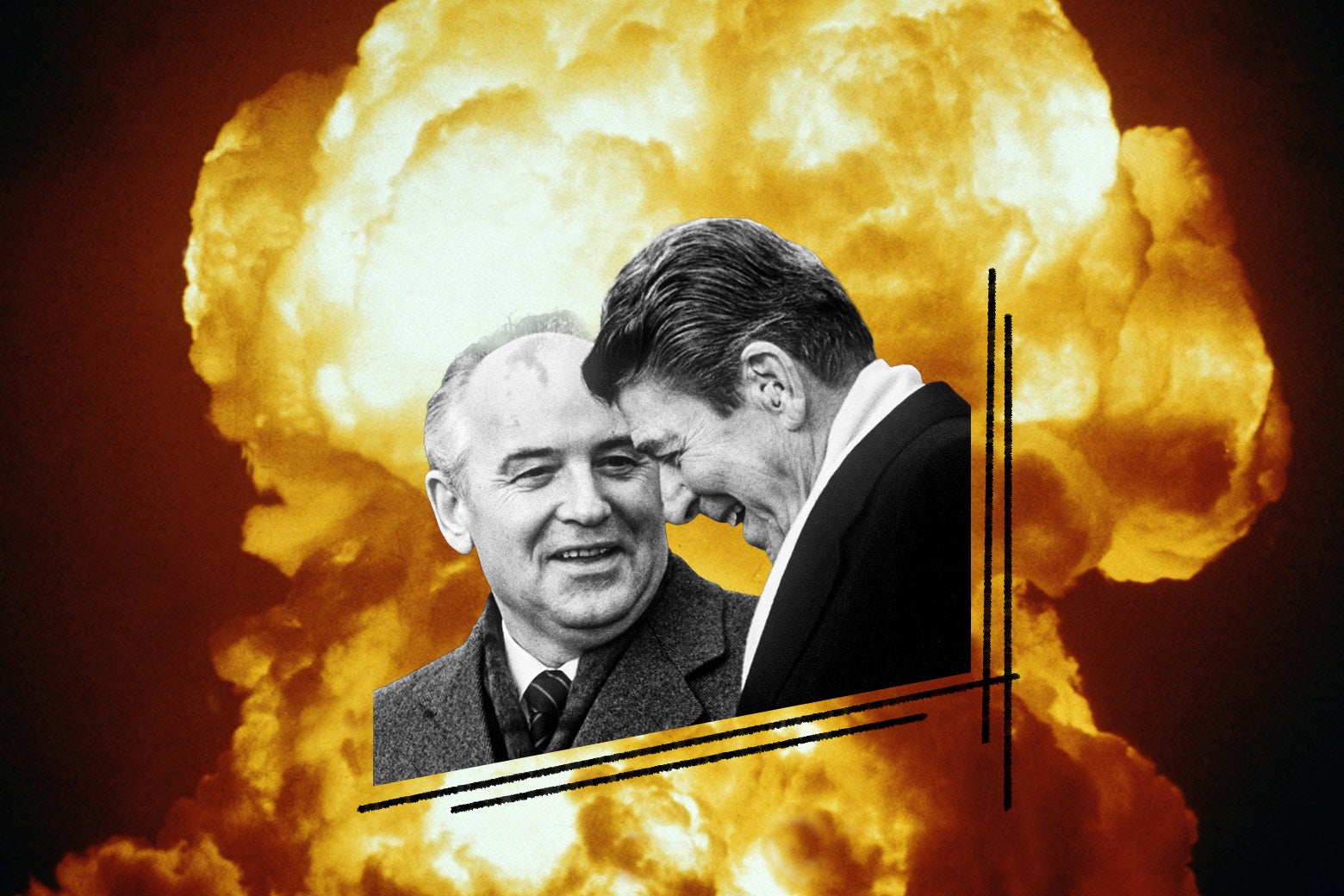
"The year was 1986: a time of Cold War espionage and deep suspicion. Relations between Washington and Moscow were starting to thaw, yet a staggering stockpile of almost 70,000 nuclear warheads meant the threat of annihilation lingered in the air. Then something pretty extraordinary happened: Soviet leader Mikhail Gorbachev sent a letter to Ronald Reagan proposing they "enter the third millennium without nuclear weapons.""
""It cemented the idea that nuclear disarmament is something that we need to aspire to," Nick Ritchie, professor of international security at the University of York, tells Slate. Fast forward to today, however, and that nuclear-free vision is yet to materialize. Nuclear stockpiles are creeping up again (we're now at around 12,400), and the world appears to be drifting toward a "new nuclear arms race" that is prompting concern among experts."
"Central to the idea of global nuclear disarmament was the historic Reykjavik Summit of October 1986 in Iceland, where, alongside top negotiators and aides, Reagan and Gorbachev met in person and nearly agreed to a nuclear-free future. It had already been quite a year: the doomed Challenger space shuttle had exploded months earlier, and the disaster at Chernobyl was on everyone's minds."
In 1986, Cold War tensions coexisted with a huge nuclear arsenal of nearly 70,000 warheads. Soviet leader Mikhail Gorbachev proposed to Ronald Reagan that they 'enter the third millennium without nuclear weapons,' leading to the Reykjavik Summit where the two leaders nearly agreed to eliminate global nuclear arms. The summit reinforced nuclear disarmament as an aspiration but failed to produce lasting elimination. Since then nuclear stockpiles have fallen to about 12,400 yet are now rising again amid treaty expirations, renewed geopolitical tensions, and accelerating atomic programs, raising concerns of a new nuclear arms race. Lessons from 1986 may inform current diplomacy.
Read at Slate Magazine
Unable to calculate read time
Collection
[
|
...
]