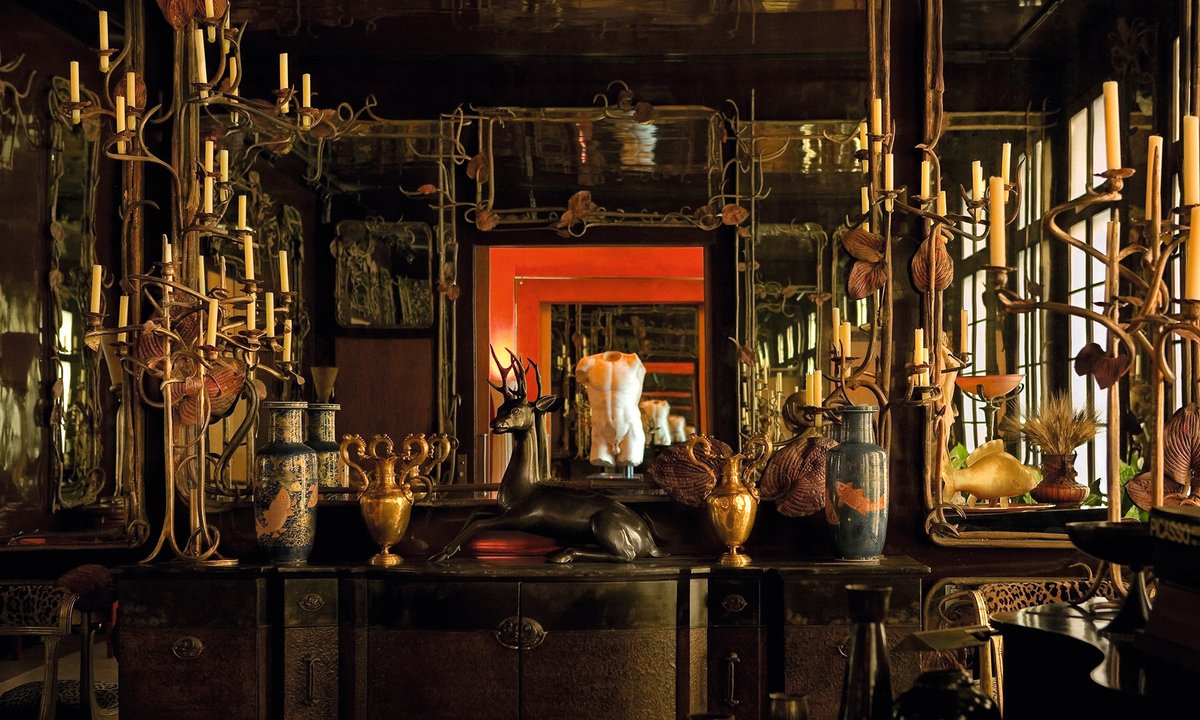
Hector Guimard's distinctive designs are well known - even if his name isn't. His signature work, the Paris Métro entrances, are classic examples of Art Nouveau, characterized by their elegant flowing lines, floral ornamentation, geometric forms, and mythical symbolism, taking inspiration from nature.
The Louvre accumulated considerable delays in the deployment of its security equipment, in favour of an event-driven policy, a judgment Des Cars said was unfair.
Robert Therrien's 'Under the Table' is a 10-foot-tall sculpture that captivates visitors, inviting them to experience its scale and intricacies from below. The piece exemplifies Therrien's ability to transform everyday objects into monumental art.
From unassuming hunks of Carrara marble and limestone, Matthew Simmonds carves realistic, miniature gothic cathedral arches, stairwells, and colonnades. Often based on architectural details of real places, such as cities around Tuscany and Germany's Bamberg Cathedral, the sculptures portray intimate details of corners, vaulted ceilings, arcades, and stairwells that can sometimes be peeked through additional apertures.
At the official launch last November, the current culture minister Rachida Dati described the imperative behind the programme as not just celebrating an uncommon visionary but the "burning relevance" of his legacy: "a commitment to continuing to nurture this demanding idea of what culture is".
The Neptune of Lyon, one of the largest and most important bronze statues from Roman Gaul, has arrived in Rome for a one-time guest starring appearance at the Giovanni Barracco Museum of Ancient Sculpture. The statue is in the permanent collection of the Lugdunum Musee et Theatres Romains in Lyon, and is being loaned to the sculpture museum as part of an extraordinary exchange of ancient works between the two cities.
The longer we wait, the more difficult it will become to remedy the damage. Since 2019, state funding had all but dried up, forcing the foundation to auction works to raise funds to continue the restoration of both the iconic building and its many site-specific works.
There's something about trendspotting in France that just hits differently. Maybe it's the Haussmannian architecture, which provides such a charming backdrop that you almost don't even notice you're literally running from showroom to showroom. Or maybe it's the fact that some of the brands on display truly are new - and in some cases, not even available stateside yet. Whatever the reason, I look forward to Maison&Objet and Paris Déco Off, two furniture- and textile-forward events in Paris, each January.
The question of how fashion is archived - what enters the museum; what is deemed worthy of preservation; whose clothes are considered culturally significant enough to outlast the bodies that wore them - has long sat uneasily at the centre of fashion history itself. Institutions have tended to answer it, or ignore it, in much the same way: couture gowns under glass, luxury garments mounted on conservation-grade mannequins in blockbuster exhibitions - an implicit hierarchy of the designed over the worn, the authored over the anonymous.
Working bead by bead, the artist recreates delicate blossoms that echo the organic irregularities of real flowers while shimmering with the luminosity of glass. From airy wildflower stems to full, colorful bouquets, each arrangement captures the fleeting beauty of botanical forms that remain permanently in bloom.
The foundation's collection is exceptionally large, encompassing more than 10,000 items-including thousands of drawings, over 400 sculptures, 100 paintings, a whole collection of decorative objets d'art, prints, everything that was in the studio, all the archives. Most of the collection has never been exhibited.
The artist is known for his absurdist paintings of animals with overly long legs, contorted bodies, or myriad mutant-like heads or limbs. They're often set amid woodlands or meadows evocative of 18th- and 19th-century academic landscape paintings or depictions of formal hunts. Instead, both domesticated and wild animals graze as normally as they would without dozens of heads or udders attached in unnatural places around their bodies.
If you've walked around any of France's cosmopolitan cities in recent years, you're sure to have come across some stunning murals. Painted onto the side of buildings, in hidden corners, and just about anywhere an artist can paint, street art is booming. We're not talking old-school graffiti here, hastily sprayed names on walls, and anti-social stuff like that. Today's street art is commissioned by city or town councils and created by prominent street artists from around the globe says Suzanne Pearson.
Running from March 17 to July 19, 2026, Renoir and Love will be one of the top special exhibitions of the year in Paris. Celebrating how affection, connection and human relationships shaped Renoir's work during a defining period of his career. Bringing many key works together for the first time in decades, the exhibition offers a fresh perspective on how Renoir approached love not as an abstract ideal, but as something lived and experienced within the changing social life of late-19th-century Paris.