Business
from24/7 Wall St.
1 day agoULTY's Weekly Payouts Collapsed 80% in 2025, Now Recovering to $0.40
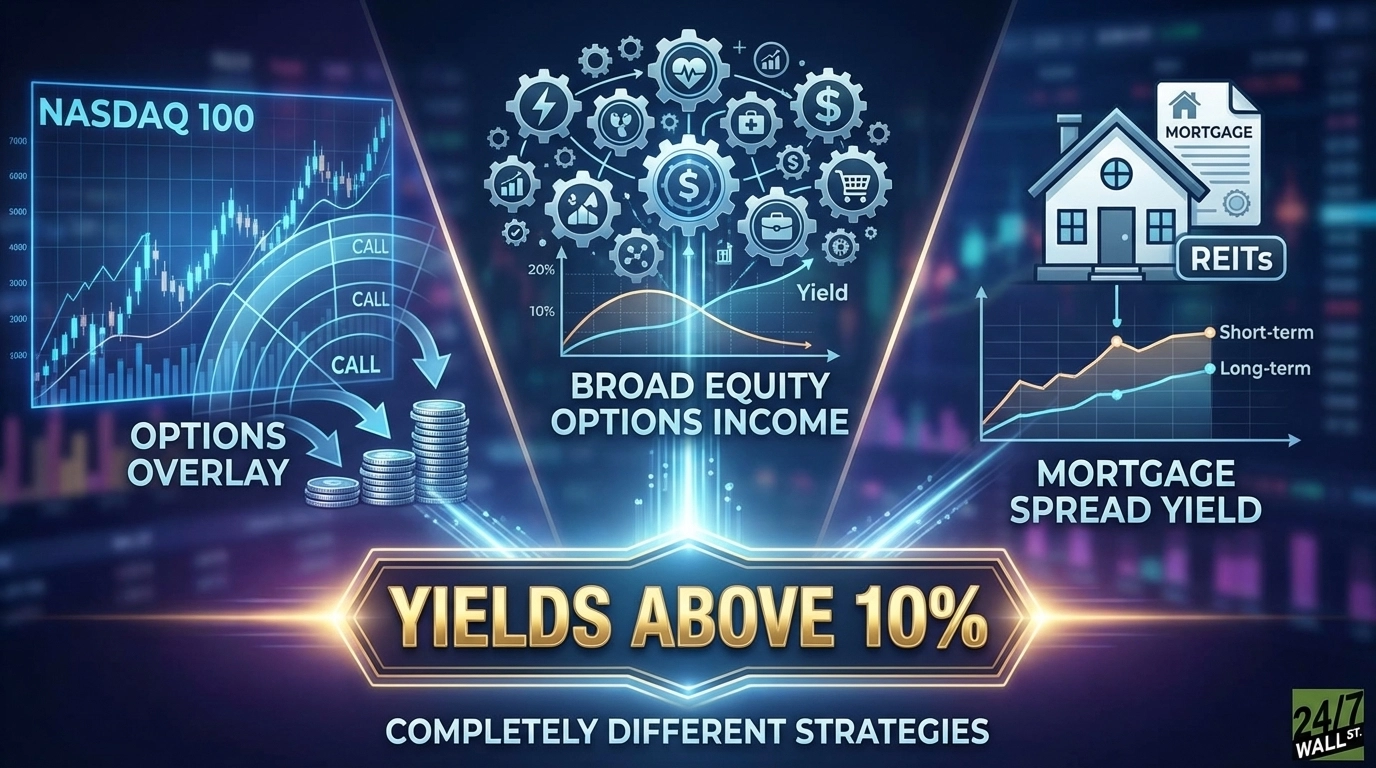
ULTY generates yield through options strategies on high-volatility stocks, not from dividends, leading to variable distributions for investors.
MORT holds shares in mortgage real estate investment trusts, companies that borrow at short-term rates and invest in mortgage-backed securities or originate real estate loans. The income MORT distributes comes from the dividends paid by the underlying mREITs to their shareholders.
Brookfield Renewable pays a quarterly distribution of $0.392 per unit, annualizing to roughly $1.57. With the stock trading around $39.36, that puts the yield in the neighborhood of 4%, and the company just announced a 5% distribution increase. The next payment hits March 31, 2026.
EMLC holds government bonds issued by emerging market countries in their own currencies, such as Brazilian reals, Indonesian rupiah, and Mexican pesos. Each month, EMLC passes interest income to shareholders as a distribution. Recent monthly payments have ranged from $0.1149 to $0.1390 per share, and the fund has made 161 consecutive monthly payments since its July 2010 inception with no gaps or suspensions.
The ProShares Russell 2000 Dividend Growers ETF tracks the Russell 2000 Dividend Growth Index, which screens for small-cap companies that have raised their dividends every year for at least the past 10 consecutive years. That single requirement does most of the quality filtering. A company that has grown its dividend for a decade has almost certainly demonstrated stable cash flows, disciplined management, and enough earnings durability to survive at least one or two economic downturns.
Brown-Forman paid $420 million in dividends in FY2025 against $431 million in free cash flow, producing an FCF payout ratio with almost no cushion. That 1.03x FCF coverage should give income investors pause. It has tightened from 1.21x in FY2023 and 1.04x in FY2024. Recent FCF has been partially supported by inventory drawdowns.
AMLP holds a concentrated basket of midstream MLPs that earn fee-based revenue by moving oil, natural gas, and refined products through pipelines and processing facilities. These companies collect tolls on volumes transported rather than betting on commodity prices, creating relatively predictable cash flows.
In addition, if the January consumer price index number, to be posted on Friday, comes in below expectations, there may be no rate cuts until the summer, if then. The best move for growth and income investors seeking solid passive income is to start adding top companies now, as interest rates will rise with no help from the Federal Reserve.
The Vanguard Utilities Index Fund ETF Shares ( NYSEARCA:VPU) generates its 2.73% dividend yield by holding a diversified portfolio of 67 utility companies across the electric, gas, and water sectors. Investors receive quarterly distributions funded by the dividends these underlying holdings pay out. VPU manages $9.8 billion in assets while charging just 0.09% in annual fees, making it one of the most cost-efficient ways to access utility sector income.
The SPDR Portfolio S&P 500 High Dividend ETF (NYSEARCA:SPYD) invests in 80 high dividend-yielding companies and tracks the performance of the S&P 500 High Dividend Index. Since it holds limited stocks, you get to own the best of the industry. It aims to provide dividend income and the potential for capital appreciation. The ETF has a yield of 4.57% and an expense ratio of 0.07%. Besides the quarterly dividends, the fund has generated a 1-year return of 4.67% and a 3-year return of 7.85%.
With Meta Platforms (NASDAQ: META) trading at approximately $659 per share, it is currently about 16% lower than its 52-week high. Do you believe that META stock is a solid long-term investment at its current price? How do you feel about buying it at a 30% discount for around $460 per share? If you see that as a bargain and have some funds ready, consider this trading opportunity.
Most U.S. investors never look beyond domestic stocks for dividend income, and the reasoning, at least on the surface, seems logical. Given currency risk, unfamiliar names, differing accounting standards, and the perception that international markets are riskier and/or less transparent, this lack of consideration seems reasonable. However, as a result of this same consideration, this bias ultimately leaves money on the table, and while US dividend stocks infrequently reach 4-5% yields without serious risk, international markets offer established companies with sustainable business models
One of the most important things to remember is that if you want to build up wealth, it's different than retirement income, and if you're on the former side, you want to start accumulating money now. If you're trying to live off your portfolio now, volatility can become highly personal, as a 20% drop in the market over time isn't a buying opportunity, it's actually the money you need for rent and living.
If you've got sidelined capital ready to put to work, you might want to consider the high-yielding JPMorgan Nasdaq Equity Premium Income ETF (JEPQ), operating on all cylinders. With a high yield of 10.1% that far exceeds the broader market on top of $32.6 billion in total assets under management, JEPQ has delivered a double-digit percentage return over the past six months alone of approximately 11%.
As new bonds get issued at lower rates and cash rates decline, investors start to quickly look for ways they can rotate out of these asset classes and move somewhere else that pays income. Enter the income-generating monthly ETF, which often benefits twice in these kinds of environments as its yields stay competitive and the share price tends to rise as demand increases. In other words, investors win on both sides as they get a shareholder boost thanks to growth, all while receiving monthly "paychecks."
If you're a retiree or nearing retirement, you should be thinking about investments with steady income streams. Ideally, you'll reinvest that income, but you also have the option of cashing out your dividends if needed. This passive income can supplement your retirement account withdrawals and Social Security. Some retirees will use dividends to cover ongoing costs such as housing and groceries.
When income matters more than growth, retirees turn to funds that deliver quarterly checks without volatility. The iShares Core High Dividend ETF ( NYSEARCA:HDV) yields 3.3%, triple the S&P 500's 1.03%. That difference translates to predictable cash flow for investors who need their portfolio to pay bills. Built for Income, Not Speculation HDV tracks 75 U.S. companies screened for dividend sustainability and financial health. The fund concentrates in defensive sectors where cash flow holds up when growth stocks stumble.
Most dividend stocks and dividend ETFs pay quarterly, and this creates awkward gaps if you're trying to cover monthly expenses. It's thus a good idea to look into monthly dividend ETFs like Invesco S&P 500 High Dividend Low Volatility ETF (NYSEARCA:SPHD ) , SPDR Dow Jones Industrial Average ETF Trust (NYSEARCA:DIA ) , iShares 20+ Year Treasury Bond ETF (NASDAQ:TLT ) . They align much better with most people's rhythm of life, and they also compound faster than quarterly payouts.