#silicon-sampling
#silicon-sampling
[ follow ]
#semiconductors #intel #terafab #ai #spacex #tesla #elon-musk #semiconductor-manufacturing #chip-manufacturing

#semiconductors
World politics
fromSilicon Canals
3 weeks agoInside the quiet restructuring of global semiconductor supply chains: how TSMC, Samsung, and Intel's subsidy race is creating three separate technological civilisations - Silicon Canals
Governments are investing heavily in semiconductor production, leading to the creation of three distinct technological ecosystems.

World politics
fromSilicon Canals
3 weeks agoInside the quiet restructuring of global semiconductor supply chains: how TSMC, Samsung, and Intel's subsidy race is creating three separate technological civilisations - Silicon Canals
Governments are investing heavily in semiconductor production, leading to the creation of three distinct technological ecosystems.


fromThe Verge
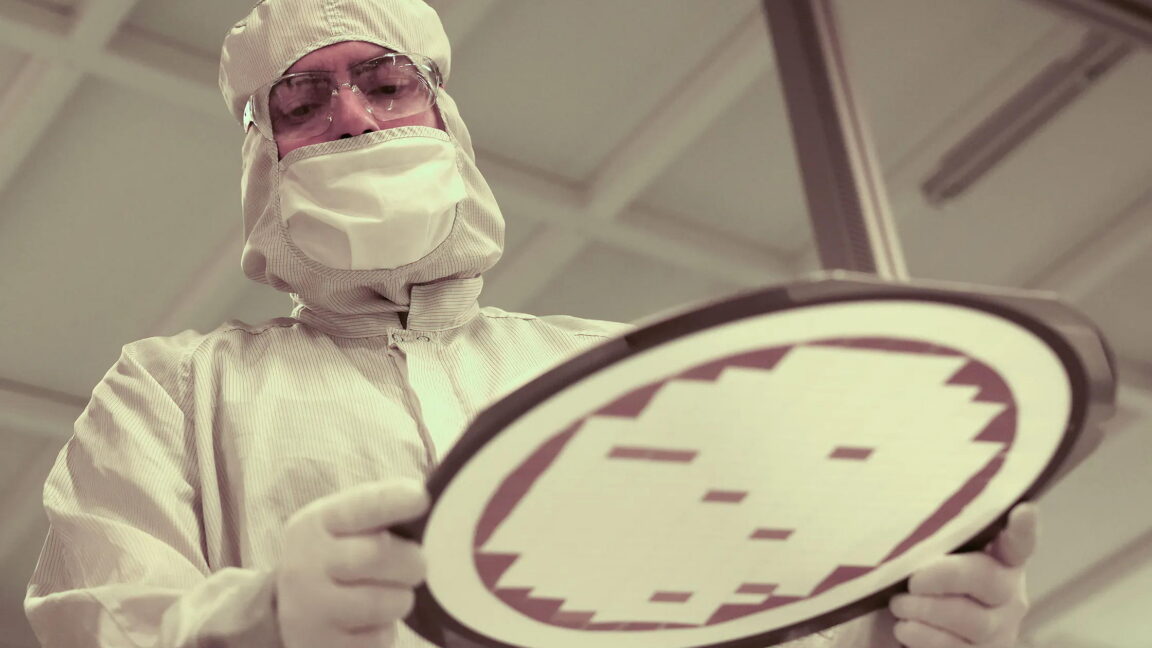
4 days agoIntel will help build Elon Musk's Terafab AI chip factory
Terafab will close the gap between today's chip production and the future's demand - a future among the stars. This reflects the ambitious vision behind the project, aiming to meet the growing needs of AI technology.
Toronto startup
fromTNW | Startups-Technology
2 weeks agoLace raises $40M to replace chip-making light with helium atoms
Lace Lithography uses a beam of helium atoms rather than light to etch chip patterns, achieving a width of approximately 0.1 nanometres, which is about 135 times finer than ASML's EUV light.
European startups
fromTechRepublic
1 month agoMeta's New AI Chips Reveal a Faster, More Self-Reliant Hardware Strategy
Meta is building these chips because buying AI hardware at scale is expensive, and relying too heavily on external suppliers leaves less room to shape that hardware to its own needs. Building more in-house could help the company keep AI costs in check.
Artificial intelligence
from24/7 Wall St.
1 month agoAMAT and Micron still winning in AI trade despite QQQ and sector weakness
The need for higher performance and more energy-efficient chips is driving high growth rates for leading-edge logic, high-bandwidth memory and advanced packaging. These are areas where Applied is the process equipment leader, and we expect to grow our semiconductor equipment business over 20 percent this calendar year.
Artificial intelligence
Design
fromArchDaily
1 month agoFacing the Age of Robots? Material Innovation in Architectural Structures
Robotic technology in construction extends beyond automation and cost reduction to fundamentally reshape architectural design, material experimentation, and construction methodologies through collaborative human-robot workflows.


Roam Research
fromdesignboom | architecture & design magazine
1 month agomushroom-inspired devices convert wasted energy into reusable power to charge gadgets
Spoa devices harvest wasted electromagnetic fields from household environments to generate reusable electricity for charging gadgets and appliances.
Science
fromwww.theguardian.com
3 weeks agoIs this the world's first quantum battery? Australian scientists say so
Australian scientists created the first quantum battery prototype that completes a full charge-discharge cycle, demonstrating that larger quantum batteries charge faster due to collective quantum effects.
fromComputerworld
4 weeks agoData mining? Old servers could become new source of rare earths
Korea Zinc, which it described as one of the world's largest smelters, is in talks with major US technology firms to recycle data center waste and extract rare earth. The move comes almost one year to the day after China announced immediate export controls on seven more rare earth elements critical to enterprise IT hardware manufacturing.
European startups
Artificial intelligence
from24/7 Wall St.
1 month agoIf You Haven't Already Bought Micron, Here Are 300 Reasons Why You Should
Micron Technology benefits from explosive AI-driven demand for memory chips, positioning it as a critical supplier despite trading at discounted valuations relative to growth potential.
fromThesanjoseblog
1 month agoNokia Subsidiary Launches Photonic Semiconductor Facility in South San Jose
Infinera Corp., a Nokia subsidiary, purchased the 82,000-square-foot facility at 6373 San Ignacio Avenue for nearly $27 million. The team will convert this former headquarters in South San Jose into a dedicated photonic semiconductor fabrication plant.
Silicon Valley real estate
European startups
fromTechzine Global
1 month agoFirst factory for InP photonic chips on 6-inch wafer scale in the Netherlands
Eindhoven is building the world's first industrial factory for indium phosphide photonic chips on 6-inch wafers, funded by €150 million from the EU Chips Act and PIXEurope consortium.
fromTheregister
1 month agoBroadcom says AI companies can't make their own silicon
Our custom accelerator business is progressing very well across five customers. Anthropic will soon implement one gigawatt of Broadcom-baked TPUs, and we expect the AI company plans a three-gigawatt deployment in 2027. Meta will install multiple gigawatts of Broadcom's XPU accelerators in 2027 and beyond. OpenAI will deploy over one gigawatt of compute capacity based on custom XPUs in 2027.
Artificial intelligence
Science
fromNature
1 month agoMultimodal electron microscopy of halide perovskite interfacial dynamics - Nature
Halide perovskite LEDs suffer rapid operational degradation due to ion migration and interfacial electrochemical reactions, requiring atomic-scale in situ imaging to understand degradation mechanisms and improve device stability.
Science
fromSFGATE
1 month agoExperts skeptical this California startup can turn night into day
A Los Angeles startup plans to deploy thousands of satellites with large mirrors to reflect sunlight onto Earth at night for commercial illumination, but scientists warn of severe ecological and environmental consequences.
frominsideevs.com
1 month agoDonut Lab's Latest Solid-State Battery Test Proves It Isn't A Supercapacitor
When the Finnish startup unveiled its battery at the Consumer Electronics Show in January, the specifications shocked the battery industry. How could an unknown company leapfrog Toyota, Factorial, and CATL in the solid-state race? The startup claimed 400 watt-hours per kilogram of energy density, a 100,000-cycle lifespan and a charge time of roughly five minutes.
Science
Tech industry
from24/7 Wall St.
1 month agoWhy ASML Investors Shouldn't Worry About Competition From China
ASML maintains an unassailable monopoly on EUV lithography equipment due to 30+ years of R&D, 100,000 components from 5,000 suppliers, and impenetrable patents, making Chinese competition unlikely before 2030.

fromSecurityWeek
1 month agoNIST's Quantum Breakthrough: Single Photons Produced on a Chip
NIST has developed a chip that reliably emits a single photon on demand. This ability will improve the efficiency of QKD (quantum key distribution) as we prepare for the arrival of quantum computers. Quantum computers will upend current cryptology by using Shor's algorithm to rapidly negate the current public/private key secure encryption methods. This has largely been solved by NIST's post quantum cryptology (PQC) algorithms.
Information security
fromTechzine Global
1 month agoASML wants to go beyond EUV: expansion into advanced AI chips
We look, not just for the next five years, we look at the next 10, maybe 15 years. The focus is on advanced packaging and a possible expansion of the chip size that ASML's machines can handle, positioning the company to capitalize on the rapidly evolving AI chip manufacturing landscape.
European startups
fromFast Company
2 months agoMost scientific inventions don't leave the lab. This VC firm is changing that
But he'd been considering an idea for new technology-an autonomous, wind-powered cargo ship. Then, while on paternity leave in 2024, he discovered a free program that helps scientists and engineers launch businesses for the first time. Weeks after finishing the program, called 5050, Cymbalist had launched a startup called Clippership. The company's first ship is being built in the Netherlands this year. Without the accelerator, he says, the company likely wouldn't exist.
Startup companies
fromwww.nature.com
2 months agoExciplex-enabled high-efficiency, fully stretchable OLEDs
Here we addressed this challenge by incorporating an intrinsically stretchable exciplex-assisted phosphorescent (ExciPh) layer. The elastomer-tolerant triplet-recycling mechanism mitigates exciton energy transfer limitations arising from the insulating elastomer matrix, yielding a light-emitting layer with more than 200% stretchability and an external quantum efficiency (EQE) of 21.7%. To translate this performance to fully stretchable devices, we integrated MXene-contact stretchable electrodes (MCSEs), which feature high mechanical robustness and tunable work function (W
Wearables
fromwww.mercurynews.com
1 month agoApplied Materials to pay $252.5 million to settle US probe
Applied Materials Inc. will pay $252.5 million to settle a US Commerce Department investigation into improper exports to China, ending a yearslong saga for the largest American supplier of chipmaking machinery. The agreement resolves allegations by the Commerce Department's Bureau of Industry and Security that certain shipments to China between November 2020 and July 2022 didn't comply with export regulations, the company said in a statement Wednesday.
Silicon Valley
Tech industry
from24/7 Wall St.
1 month agoSynopsys Beats on EPS and Revenue as AI-Fueled Chip Design Demand Remains Strong
Synopsys beat Q1 FY2026 earnings expectations but faced mixed market reaction due to Q2 revenue guidance missing estimates and China export concerns, though AI growth and the Ansys acquisition remain positive drivers.
Artificial intelligence
fromwww.scientificamerican.com
1 month agoHow one chemist is using AI and robots to automate lab experiments
AI-driven laboratory automation like Coscientist accelerates chemistry by reducing repetitive work, improving accuracy, and enabling experiments previously limited by human error or fatigue.
Science
fromenglish.elpais.com
2 months agoThe technology that reveals what happens in 0.00000000000000000000001 second
Attosecond-scale light pulses reveal ultrafast electron dynamics, enabling new studies of materials, quantum processes, and biological structures, and have earned major scientific awards.
fromNature
1 month agoNanoscience is latest discipline to embrace large-scale replication efforts
Calling nanoscientists: your field needs you to try to replicate a landmark finding that quantum dots can act as biosensors inside living cells. As part of the first large-scale effort in the physical sciences to tackle the reproducibility crisis, researchers in France and the Netherlands are offering funds and resources in exchange for a few months of work. "We are trying to use
Science
Science
fromwww.nature.com
2 months agoAuthor Correction: An autonomous laboratory for the accelerated synthesis of inorganic materials
Prediction platform correctly identified 36 of 40 synthesized compounds; four were inconclusive, and novelty claims were clarified as 'new to the prediction platform', not new to science.
fromNature
1 month agoMaximizing perovskite electroluminescence with ordered 3D/2D heterojunction - Nature
Metal halide perovskites have emerged as a material for LEDs owing to exceptional luminescent properties and cost-effective solution processability4,5,6,7,8,9,10. Quasi-2D PeLEDs have demonstrated superior device performance and reproducibility because of their quantum well structures9,11,12,13,14,15,16. However, quasi-2D perovskites are usually composed of hybrid and random 3D-2D phases and face two critical challenges: (1) abundant surface defects will lead to severe non-radiative recombination7,17,18,19 and (2) notable energy disorder will interrupt charge transport, hence reducing device efficiency20,21.
Science
[ Load more ]