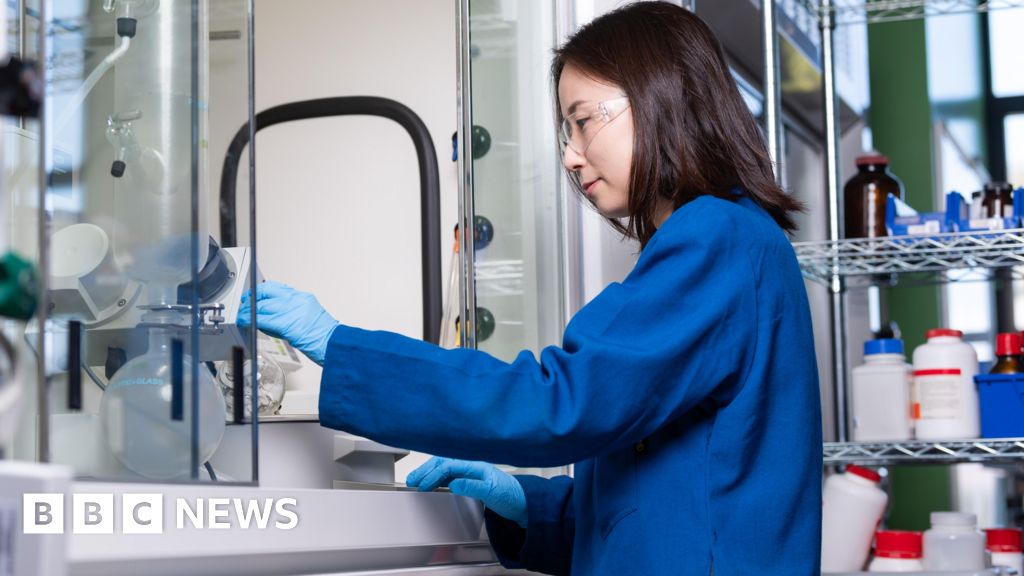
"When chemistry professor Grace Han first visited southern California from Boston some years ago, she noticed the difference. How her skin would tingle with the first signs of irritation after just a few hours outside. Last year, she moved to take a job at the University of California, Santa Barbara, and regularly began wearing a large-brimmed hat, sunglasses and plenty of sun cream."
"Those molecules change shape when irradiated by the sun, flexing into a strained version of their regular form. For decades, scientists have sought out molecules that can twist their shape, storing energy in the process, and then be prompted to revert to their original shape, releasing the stored energy on demand. A bit like setting and later triggering a mousetrap. It's known as molecular solar thermal (Most) energy storage and is a potentially very cheap and emissions-free way of supplying heat."
"It's important to activate the shape-shifting of the energy-storing molecules in a smooth, repeatable way. Luckily, millions of years of evolution has perfected this process when it occurs in our skin we are all living chemistry labs, in a sense. DNA molecules in our skin have evolved so that they can repair their sun-contorted shape with the help of an enzyme called photolyase."
"And such molecules, realised Han, were perfect candidates for an energy storage system. "They are very, very small," she explains. "And can store a massive amount of energy per mass.""
DNA molecules in skin are damaged by sunburn when irradiated by sunlight, changing shape into a strained form. Scientists have long pursued molecular solar thermal energy storage, where molecules twist to store energy and later revert to release it on demand. Grace Han connected her experience of sun irritation with DNA photochemistry and identified skin DNA as a promising candidate. DNA molecules are extremely small and can store a large amount of energy per unit mass. In living skin, evolution has already optimized a repeatable process for restoring DNA shape using an enzyme called photolyase, supporting smooth, controllable activation and release of stored energy.
Read at www.bbc.com
Unable to calculate read time
Collection
[
|
...
]