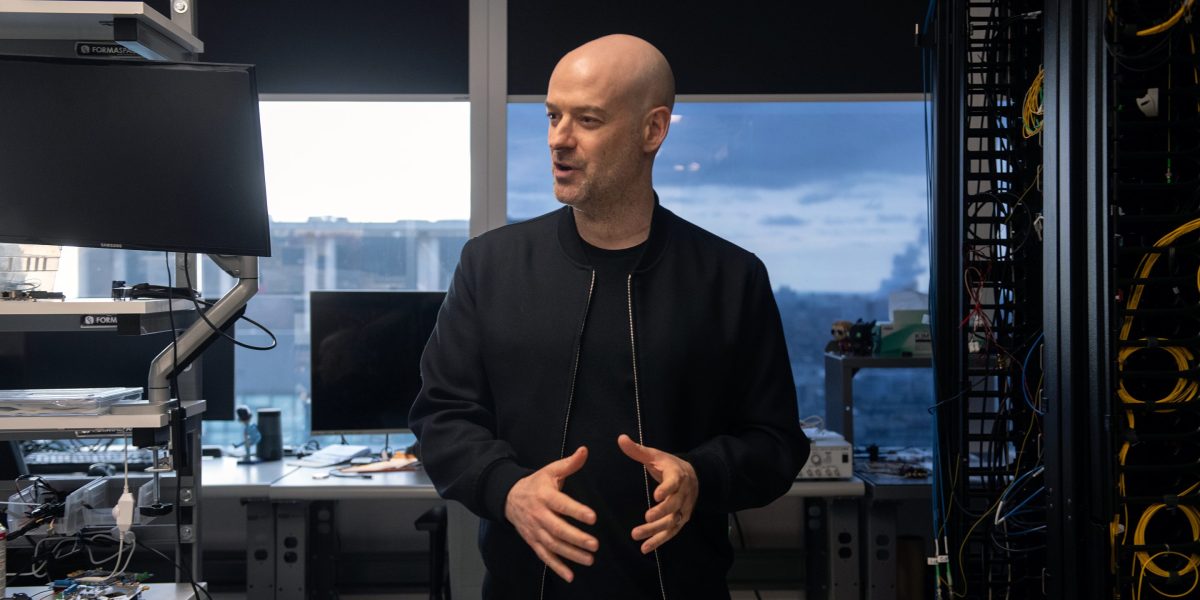
In the 1950s through the 1980s people thought of quantum effects as occurring in very small things and as a source of noise-you had to understand quantum theory to build transistors. People thought of quantum mechanics as a nuisance. He and Brassard discovered methods-like quantum coin-tossing and quantum entanglement-that turned the perceived handicaps of quantum reality into a powerful tool.
Pasqal is a full-stack quantum computing company taking on Big Tech. It generates annual revenue in the tens of millions from selling hardware, software and cloud services to labs and industry partners.
Archer reported Q4 2025 revenue of $300,000, a figure that is a milestone for the company: it represents the company's first-ever revenue recognition. The company posted an EPS loss of -$0.26 for the quarter, with a net loss of $188.9 million and operating expenses of $234.70 million, partly inflated by a $36.10 million jump in non-cash stock-based compensation.
For over 15 years, the EFRC program has provided a transformational research environment that has brought together the strengths of our National Laboratories and universities to accelerate discovery, develop innovative tools, and train the next generation of the American energy science workforce. The EFRCs will continue to play a vital role in bridging disciplines and institutions, advancing foundational science and strengthening America's leadership to push forward scientific frontiers critical for new energy technologies.
Performance: A Brutal Start to 2026 Rigetti is down 27.36% year-to-date and 37.44% over the past month. The stock peaked at $58.15 in mid-October but has since given back most of those gains. For context, the one-year return still sits at 31.35%, but momentum has clearly reversed. The company trades at a 660x price-to-sales ratio with $7.49 million in trailing twelve-month revenue and a $4.95 billion market cap.
The quantum computing stocks boomed for most of 2025, only to go bust in the last quarter. In 2026, it's been mostly looking lower for many of the top quantum plays, including some of the more speculative plays. That said, the technology is still worth keeping tabs on, even as the quantum pure-play stocks continue to take more backward steps. Of course, investors have taken on more of a risk-off approach in the past couple of quarters.
As investors turned their back on software (notably, the seat-based software-as-a-service companies), they're turned towards hardware in a big-time way. You wouldn't know it by looking at those flat shares of Nvidia ( NASDAQ:NVDA), but the iShares Semiconductor ETF ( NASDAQ:SOXX) is up around 13% year to date, with few signs of slowing down. The winners within semis have been broad, but the undisputed kings of the 2026 semiconductor surge belongs to the memory and storage stocks.
Bull has been officially launched as an independent brand for high-performance computing, artificial intelligence, and quantum computing. The historic technology brand, which has been part of Atos for many years, is making a comeback. The reintroduction of Bull, originally founded in 1931 to manufacture tabulating machines, comes after the signing of a share purchase agreement with the French state on July 31, 2025.
The effort comes as competition for AI talent intensifies worldwide and tech workers in the US grapple with layoffs, burnout, and visa complications. According to BCG's 2024 talent tracker report, the US remained dominant in attracting AI talent worldwide. Already known for its tech scene, Finland, with a population of around 5.6 million, is positioning itself as a place where American tech workers can find a better work-life balance without sacrificing their careers - a notable contrast to the famous grindset of Silicon Valley.
A team based at the University of Vienna put individual clusters of around 7,000 atoms of sodium metal some 8 nanometres wide into a superposition of different locations, each spaced 133 nanometres apart. Rather than shoot through the experimental set up like a billiard ball, each chunky cluster behaved like a wave, spreading out into a superposition of spatially distinct paths and then interfering to form a pattern researchers could detect.
Cisco aims to "build high-fidelity quantum networks to unlock the potential for large-scale quantum data centers," Kompella told Telecompetitor in an interview. The company is working closely with IBM on the research, with IBM's role focused primarily on the computing side, while Cisco tackles the networking side. Quantum computers use concepts of quantum physics. They're more powerful than traditional non-quantum computers, known in quantum jargon as "classical" computers. But, as of today, there is no way to network quantum computers.
I have been thinking about the future and how we might respond to it. We are sliding into a period of transition like no other, most likely triggered in three waves; AI, quantum computing and the brain computer interface. Artists have a role to look into the mists and, when they catch sight of something, to hold up a mirror.
Nowadays, we're told quantum computing will be the next big thing. All with the ability to solve problems far too complex for typical computers within minutes, or even seconds. In fact, "Overall, the global quantum computing market is expected to grow from $1.6 billion in 2025 to $7.3 billion by 2030, according to BCC Research. That represents a compound annual growth rate of 34.6% over the next five years," added U.S. News & World Report.
Exploring Quantum Computing & Python Frameworks What are the recent advances in the field of quantum computing and high-performance computing? And what Python tools can you use to develop programs that run on quantum computers? This week on the show, Real Python author Negar Vahid discusses her tutorial, "Quantum Computing Basics With Qiskit." REAL PYTHON podcast
If you don't mind peering through a sheet of glass, you can see a Quantum Computer at IBM's office in Waterloo. Known as the IBM Quantum System One, it is the first circuit-based commercial quantum computer, launched by IBM in January 2019. Quantum computers are capable of using the weird world of quantum physics and simplistically, where a standard computer bit can be either a binary One or Zero, a quantum computer can be both at the same time.
In this week's edition of Computer Weekly, we take a closer look at reports of low workplace morale within the Police Digital Service, as its staff eagerly await the outcome of the long-promised Home Office's policing reform whitepaper. Jérôme Goulard, the chief sustainability officer of Orange Business, talks us through the work he is doing to balance business objectives with IT sustainability within the organisation.
On Friday, Quantum Computing Inc. released its third-quarter 2025 financials-and the company announced an unexpected earnings and revenue beat. As noted by Investor's Business Daily, Quantum Computing reported earnings per share of 1 cent. Investors had been expecting the company to post a 6-cent-per-share loss. The company also reported revenue for the quarter of $384,000. Analysts had been expecting revenue of just $100,000.