#logistics-efficiency-and-cost-reduction
#logistics-efficiency-and-cost-reduction
[ follow ]
#amazon #operational-efficiency #robotics #automation #e-commerce #productivity #supply-chain #logistics #walmart
#amazon
E-Commerce
fromwww.businessinsider.com
1 week agoInside Project Kobe: Amazon's plan to build Walmart-style supercenters powered by warehouse robots and AI
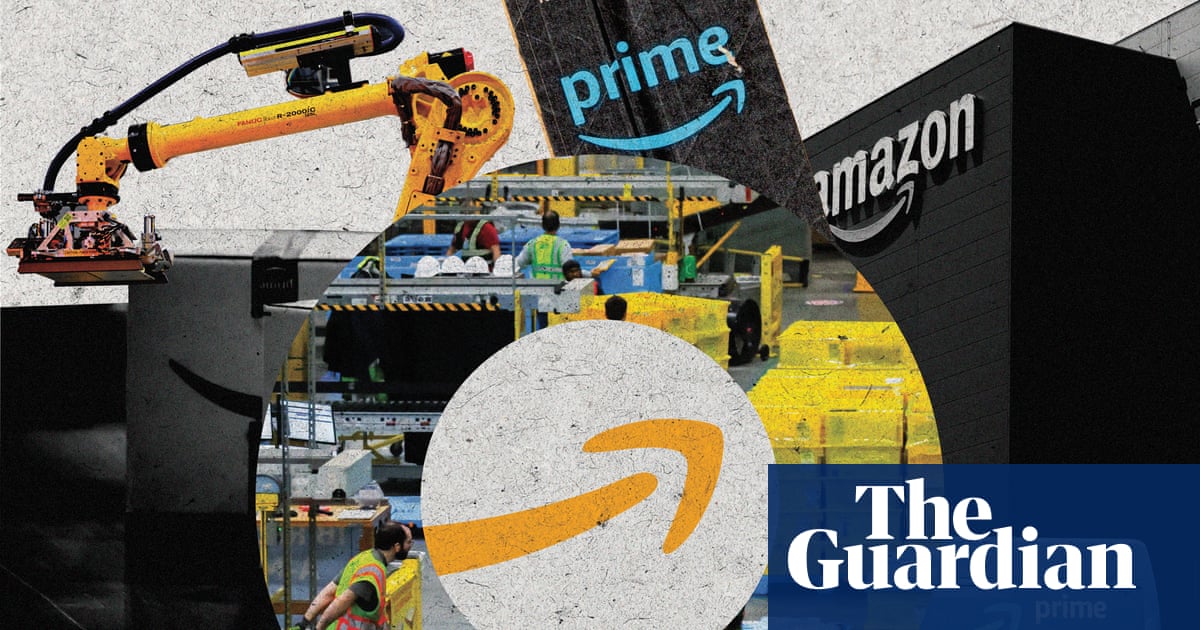
Amazon is developing large-format supercenters that integrate grocery, general merchandise, and robotics-powered fulfillment centers to compete with Walmart.

E-Commerce
fromwww.businessinsider.com
1 week agoInside Project Kobe: Amazon's plan to build Walmart-style supercenters powered by warehouse robots and AI
Amazon is developing large-format supercenters that integrate grocery, general merchandise, and robotics-powered fulfillment centers to compete with Walmart.
fromABC7 San Francisco
1 day agoAmazon, UPS, FedEx, USPS add temporary fuel surcharges to offset extra costs
"Transportation costs are a big factor there. Every company that is involved and has logistics and they have to pay for gas, either they have to absorb this cost, or they will charge the third party that will provide this service. I'm not surprised this is happening, because at some point, Amazon will say we cannot absorb all this cost."
Alternative transportation
Marketing tech
fromSilicon Canals
1 day agoAlibaba's AI tool cut one seller's costs by 85% - now the question is whether it becomes a marketplace gatekeeper - Silicon Canals
Accio has over 10 million users, transforming e-commerce sourcing by automating supplier research and product design, positioning Alibaba as a key gatekeeper.
Productivity
fromFast Company
4 days agoMany productivity programs solve the wrong problem. This is what leaders should do instead
Organizations face work design problems rather than productivity issues, leading to temporary solutions that fail to address underlying conflicts in problem-solving approaches.


fromArchitectural Digest
5 days agoI'm Done Sourcing So Much Online. Here's Why
The convenience of sourcing online is fraught with more pitfalls than most of us want to admit. Try finding adequate photos of a vintage piece's condition-close-ups of the fabric, video of damaged areas, any images of a piece's rear or underside!
UX design



#amazon-usps-contract-dispute
Washington DC
fromEntrepreneur
2 weeks agoAmazon Plans to Slash USPS Shipments by Two-Thirds. Here's What That Means for the Postal Service.
Amazon plans to reduce USPS package shipments by two-thirds by fall, threatening the financially struggling postal service that delivered over one billion Amazon packages last year.
#supply-chain-security
Business intelligence
fromLondon Business News | Londonlovesbusiness.com
3 weeks agoSecurity Seals 101: How businesses protect inventory from tampering in modern supply chains - London Business News | Londonlovesbusiness.com
Security seals provide tamper evidence throughout supply chains by visibly indicating whether packages have been opened or compromised during transit and storage.
Information security
fromSecuritymagazine
3 weeks agoThreat Actors Target the Entire Retail Supply Chain
Threat actors exploit shared supply chain vulnerabilities between wholesalers and retailers, with over 70% of retailers and 60% of wholesalers having exposed credentials, enabling widespread initial access.
UK news
fromComputerWeekly.com
3 weeks agoUnreliable fleet connectivity driving employee exodus | Computer Weekly
UK fleet operators face significant connectivity challenges that threaten competitiveness, with unreliable networks causing customer complaints and operational disruptions despite limited failover protections.
fromAxios
2 weeks agoUSPS warning raises stakes for mail-order prescriptions, higher postage prices
The mail will stop if the agency can't meet its obligations. That includes critical deliveries like prescription drug packages. Postmaster General David Steiner warned lawmakers this week that USPS could run out of cash in less than 12 months without congressional action.
Media industry
fromMedium
1 month agoFolding in Traceability
In enterprise commerce, totals don't drift because someone forgot algebra. They drift because reality changes: promos expire, eligibility changes when an address arrives, catalog data updates, substitutions happen, and returns unwind prior discounts. When someone asks "why did the total change?" you need more than narration. You need evidence - a trail of facts you can replay and a pure computation that deterministically produces the same result.
Scala
Artificial intelligence
fromFuturism
3 weeks agoFactory Paying Human Worker to Watch Robot Worker All Day
Humanoid robots like Digit are being deployed in factories with human supervisors, with costs expected to drop from $10-$25 per hour to $2-$3 per hour, potentially displacing workers earning $20 per hour.
fromEntrepreneur
3 weeks agoSelf-Driving Semi Trucks Are Coming, and They're About to Transform a $900 Billion Industry
Aurora, Kodiak, and Waabi are racing to eliminate drivers-a cost that represents up to 40% of per-mile trucking expenses, according to The New York Times. Aurora plans to grow from a handful of autonomous trucks to more than 200 by year's end, then thousands by 2027.
Alternative transportation
London startup
fromLondon Business News | Londonlovesbusiness.com
4 weeks agoHow UK manufacturers can build supply chain resilience in uncertain times - London Business News | Londonlovesbusiness.com
Supply chain resilience requires real-time visibility and diversified suppliers across multiple geographic locations to quickly recover from disruptions.
fromTechCrunch
3 weeks agoAmazon adds 1-hour and 3-hour delivery options in the US | TechCrunch
Our customers are busier than ever and are looking for new ways to save time while keeping their households running. We saw an opportunity to use our unique operational expertise and delivery network to help make customers' lives a little easier while unlocking even more value for Prime members.
E-Commerce
Gadgets
fromComputerWeekly.com
1 month agoConnectivity, AI drive fleet safety, productivity and decision-making | Computer Weekly
AI, connected data, and safety-focused services are transforming fleet operations, with GPS tracking adoption at record highs and AI delivering measurable safety improvements and cost reductions.
Miscellaneous
fromDevOps.com
1 month agoI Learned Traffic Optimization Before I Learned Cloud Computing. It Turns Out the Lessons Were the Same. - DevOps.com
Cloud infrastructure requires understanding system behavior and costs to operate effectively at speed, similar to how skilled drivers anticipate conditions rather than simply driving fast.
Artificial intelligence
fromFortune
1 month agoI help manage one of the world's most constrained supply chains, up close to the defining energy bottleneck of the decade | Fortune
Power transformer shortages are the critical bottleneck limiting AI infrastructure expansion and corporate electrification globally.
E-Commerce
fromBusiness Matters
4 weeks agoThe Hidden Costs of DIY Shipping: When to Switch to an Ecommerce Shipping Platform
DIY shipping becomes a business bottleneck as order volume grows, consuming excessive time and increasing errors while established shipping platforms automate processes and enable scalability.
fromFuturism
1 month agoAI Is Destroying Grocery Supply Chains
Whole Foods shelves sit empty after a data breach shut down its wholesale distributor. Meat packers working for JBS Foods are paralyzed as an $11 million ransomware attack takes out their processing facilities. Some 2.2 million workers at Stop & Shop and Hannaford have their personal data exposed as the result of a cyberattack on parent company Ahold Delhaize USA. These scenarios, straight from a William Gibson novel, are becoming increasingly common in supply chains across the world.
Food & drink
E-Commerce
from24/7 Wall St.
3 weeks agoLook! Up In the Sky! It's Amazon's Flywheel in Action
Amazon's drone delivery service Prime Air exemplifies how the company's e-commerce, AWS cloud, and AI divisions create a self-reinforcing flywheel that generates data, optimizes operations, and drives competitive advantage.
E-Commerce
fromBusiness Matters
1 month agoSupplier Verification: A Practical Guide for Smarter Global Sourcing
Supplier verification is a strategic necessity in global trade, requiring thorough assessment of legal status, production capability, quality systems, financial stability, and regulatory compliance before establishing business relationships.
Business
from24/7 Wall St.
2 months agoThe Warehouse Automation Seller Just Turned Profitable While the Retail Giant Builds Its Own
Investors face choosing Symbotic's newly profitable automation-as-a-service with volatile trading and insider selling or Amazon's scale-driven in-house robotics investment.
fromComputerWeekly.com
1 month agoDelivery comms, intelligent fulfilment, and AI's growing influence | Computer Weekly
Nine in ten retailers globally are planning to raise their spending on artificial intelligence (AI) to optimise their e-commerce operations over the next 12 to 24 months, with online delivery execution a key area of focus. A total of 38% of European retailers identify speed, tracking and proactive communication around the delivery process as areas where AI can deliver the greatest impact.
E-Commerce
fromBusiness Matters
2 months agoWhy Tolerance Management Is a Business-Critical Skill in Modern Manufacturing
We are now in a time of manufacturing where precision is more than a technical necessity; it's a business requirement. The more complex, globally dispersed and demanding things get, the less slack remains in the system. Under these circumstances tolerance management has become a decisive competence and affects competitiveness not only in terms of controlling costs, ensuring quality and improving production efficiency but also for long term market success.
Business
fromLondon Business News | Londonlovesbusiness.com
2 months agoHow to build a more reliable end-of-line packaging process - London Business News | Londonlovesbusiness.com
End-of-line packaging often sits at the quiet end of a production line, yet it carries an outsized responsibility. This is the final checkpoint before products leave your facility, meet customers, and represent your brand in the real world. A single error here can undo hours of upstream efficiency and compromise overall product integrity. That's why building reliability into this stage is essential for both operational efficiency and customer satisfaction.
Business
fromwww.independent.co.uk
1 month agoDoes free shipping actually exist? Marketing ploys experts want to warn you about
You're scrolling through an online retailer, like Amazon, Shein or eBay, and spot a shirt on sale for $40. You add it to your cart, but at checkout, a $10 shipping fee suddenly appears. Frustrated, you close the tab. But what if that same shirt was priced at $50 with free shipping? The likelihood that you would have bought it without a second thought is much higher.
E-Commerce
fromLondon Business News | Londonlovesbusiness.com
2 months agoIs cantilever racking right for your warehouse? - London Business News | Londonlovesbusiness.com
Designed specifically for loads with length or irregular shape, cantilever systems are widely used across manufacturing, builders' merchants, and industrial storage environments. What is cantilever racking? Cantilever racking consists of vertical columns with horizontal arms extending outwards to support loads. Unlike pallet racking, there are no front uprights or obstructions, which makes loading and unloading long items safer and more efficient. This open design allows materials to be handled by forklift, side loader, or manually, depending on the application.
Business
fromBusiness Matters
2 months ago5 Accounting Tasks Most Small Businesses Should Probably Outsource Offshore
Running a small or medium-sized business is tough enough without getting buried in spreadsheets every month. A lot of us owners and managers end up wearing too many hats, sales, customer stuff, operations, and then accounting piles on top. Those routine financial tasks eat up hours, and honestly, one slip-up can cause big headaches like tax penalties or cash flow surprises.
Business
fromAbove the Law
2 months agoWhat If Tariffs Go Away - Or Don't? How You Can Protect Your Bottom Line With Contract Intelligence - Above the Law
With the Supreme Court potentially poised to invalidate recent tariffs, organizations face a confusing scenario. Having clear visibility into contract terms - such as price adjustments and renegotiation provisions - is essential to navigating this volatility. Come join us on at 1 p.m. ET on Jan. 27 for this CLE-approved webinar, where we'll discuss the current state of the tariff conundrum and explore strategies for achieving contract visibility with the latest AI innovations.
Artificial intelligence
Artificial intelligence
fromAbove the Law
2 months agoHow You Can Streamline Business Operations With AI - Above the Law
Practical AI adoption can streamline law firm operations—legal-specific tools, iterative prompts, and client-relationship strategies improve research, efficiency, and marketing while managing hallucination and confidentiality risks.
fromSubstack
2 months agoMore Efficiency, More Demand
Geoffrey Hinton, the Nobel Prize winning computer scientist who is often referred to as the "Godfather of AI", famously asserted in 2016 that, "People should stop training radiologists now. It's just completely obvious that in five years deep learning is going to do better than radiologists." The logical expectation would be that the number of radiologists should begin to decline over time as they begin to get replaced by AI.
Artificial intelligence
fromThe Business of Fashion
2 months agoHow Integrated Technology Is Reshaping Retail Operations
The technology underpinning retail operations is under scrutiny in 2026 as fashion executives look to streamline systems with the aim to unlock efficiency, cut costs and meet consumer expectations for speed and personalisation in the shopping journey. At the retail event Lightspeed Edge on 12 January, Lightspeed - the unified point-of-sale (POS) and payments platform for SMEs such as Apricot Lane Boutique and Neal's Yard Remedies - convened industry leaders to explore the strategic imperative for integrated technology ecosystems over siloed systems.
E-Commerce
fromSocial Media Explorer
2 months ago10 Last Mile Technology Trends Transforming Urban Logistics in 2025 - Social Media Explorer
Urban logistics is entering a new era where practical technology drives meaningful results. Today, more than 55% of people live in cities, and urbanization is expected to rise to 68% by 2050, placing intense pressure on delivery networks to keep up with growing demand. U.S. e-commerce is projected to reach $1.1 trillion in sales by 2026, heightening expectations for faster and more reliable last-mile service.
E-Commerce
fromForbes
2 months agoHow To Take Advantage Of Technology In CPG Marketing
Statistics from the 2025 holiday shopping season clearly show that AI is playing a huge role in how people shop. But new research from retail payment platform Adyen found that many consumers are ready for AI to become their personal shopper. Just over half-51%-said they're open to letting AI take over the entire shopping process, including making final purchases. Millennials are the most willing to let agents do their shopping, with nearly three in five saying they are ready for such a shift.
E-Commerce
fromBusiness Matters
2 months agoHow to Determine the Markup Percentage for a Retail Business
Markup is how much you add to your cost to get your selling price. If something costs $10 and you sell it for $15 , you added $5. That's a 50 percent markup on your cost. Where people get confused is that markup isn't the same as margin, even though the terms get used interchangeably all the time. Margin measures profit as a percentage of the selling price, and markup measures it based on your costs. Same dollar, different percentages.
E-Commerce
[ Load more ]