#matter-compatible
#matter-compatible
[ follow ]
#quantum-computing #quantum-mechanics #superconductivity #physics #general-relativity #standard-model
#quantum-computing

Artificial intelligence
fromPsychology Today
3 weeks agoWhat QuantumAI Is, and Why We May Miss Its Importance
Quantum AI combines quantum computing with artificial intelligence to solve complex problems involving massive combinations of possibilities, particularly useful for drug discovery, materials design, logistics, and financial analysis.

Artificial intelligence
fromPsychology Today
3 weeks agoWhat QuantumAI Is, and Why We May Miss Its Importance
Quantum AI combines quantum computing with artificial intelligence to solve complex problems involving massive combinations of possibilities, particularly useful for drug discovery, materials design, logistics, and financial analysis.
#quantum-mechanics
Philosophy
fromwww.scientificamerican.com
3 weeks agoA 100-year-old theory might explain what's wrong with quantum mechanics
Pilot wave theory, developed by Louis de Broglie a century ago, potentially resolves quantum mechanics' paradoxes by describing particles guided by attendant waves rather than existing in superposition.
Science
fromwww.nature.com
3 weeks agoBistable superlattice switching in a quantum spin Hall insulator
Monolayer TaIrTe4 exhibits bistable superlattice switching between two lattice configurations with dramatically different periodicities, controllable through electrostatic tuning of electronic states.
OMG science
fromwww.theguardian.com
3 weeks agoPlease drive carefully: scientists plan to transport volatile antimatter for first time
CERN will transport antimatter in a truck for the first time to study why the universe contains matter instead of antimatter, addressing a fundamental physics question.
Science
fromNature
4 weeks agoMultimodal electron microscopy of halide perovskite interfacial dynamics - Nature
Halide perovskite LEDs suffer rapid operational degradation due to ion migration and interfacial electrochemical reactions, requiring atomic-scale in situ imaging to understand degradation mechanisms and improve device stability.
Science
fromwww.scientificamerican.com
1 month agoIBM scientists unveil the first ever half-Mobius molecule, with the help of quantum computing
IBM researchers created a novel ring-shaped molecule with twisted electron motion resembling a complex Möbius strip, confirmed through quantum computers and advanced microscopy.

fromNature
2 months agoThis AI has chemical expertise - and helps synthesize 35 new drugs and materials
Now, researchers have created an artificial-intelligence system that vastly simplifies and accelerates the process of chemical synthesis. The system, which is called MOSAIC and is described in a study published in Nature on 19 January, recommended conditions that researchers were able to use to generate 35 compounds with the potential to become products like pharmaceuticals, agrochemicals or cosmetics without needing to do any further trawling or tweaking.
Artificial intelligence
fromNature
1 month agoCavity-altered superconductivity - Nature
A grand aspiration of cavity quantum materials research is to uncover fundamentally new routes for controlling properties of matter by judiciously tailoring the quantum electromagnetic environment. Experiments with dark cavities revealed modified transport properties in the integer and fractional quantum Hall states of a 2D electron gas, as well as cavity-assisted thermal control of the metal-to-insulator transition in charge-density-wave systems.
Science
fromwww.nature.com
1 month agoLimitations of probing field-induced response with STM
We demonstrate how the apparent magnetic field induced lattice and CDW intensity change can be explained as a consequence of two independent experimental artifacts: a reconfiguration of atoms at the STM tip apex that alters the amplitudes of CDW modulations, and piezo creep, hysteresis and thermal drift, which artificially distort STM topographs.
Science
fromNature
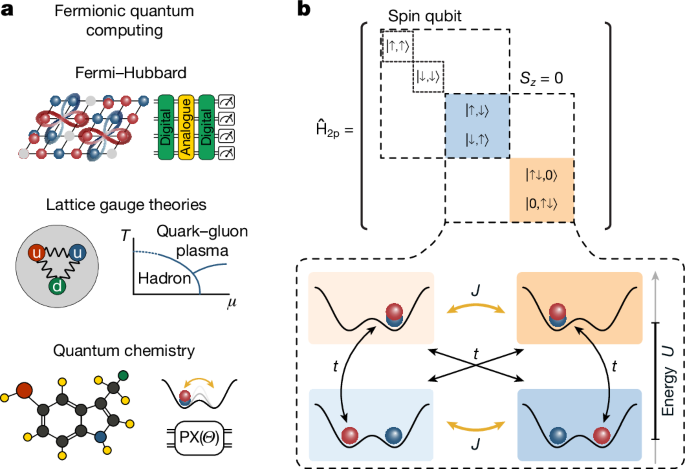
2 months agoLarge-scale analogue quantum simulation using atom dot arrays - Nature
Analogue quantum simulations are a useful tool for investigating these systems, particularly in regimes in which the applicability of numerical techniques is limited. For different simulator platforms, figures of merit include the electron bandwidth and interaction strength, temperature and the number of simulated lattice sites. Their use is further underscored by the ability to realize distinct lattice geometries, on-site degrees of freedom and by the physical observables that are accessible to experimental measurement.
Science
Science
fromenglish.elpais.com
2 months agoThe technology that reveals what happens in 0.00000000000000000000001 second
Attosecond-scale light pulses reveal ultrafast electron dynamics, enabling new studies of materials, quantum processes, and biological structures, and have earned major scientific awards.
fromNature
1 month agoNanoscience is latest discipline to embrace large-scale replication efforts
Calling nanoscientists: your field needs you to try to replicate a landmark finding that quantum dots can act as biosensors inside living cells. As part of the first large-scale effort in the physical sciences to tackle the reproducibility crisis, researchers in France and the Netherlands are offering funds and resources in exchange for a few months of work. "We are trying to use
Science
fromBig Think
1 month agoWhat are the most energy-efficient reactions in physics?
In terms of making things happen, energy is an indispensable consideration. Systems spontaneously tend towards the lowest-energy state. When a system reaches equilibrium, no further energy can be extracted. That maximum entropy, lowest energy state is the inevitable end-state of the Universe. But until that moment arrives, reactions of all kinds will occur, continuing to liberate energy. In our bodies, chemical bonds break and reform: releasing energy.
Science
fromPsychology Today
2 months agoWhat Physics Might Be If It Were Left to Psychologists
Recent integrative approaches suggest that physics cannot be adequately characterized by magnitude-based distinctions alone, such as those implied by Big-P, little-p, and mini-p physics. While these categories capture differences in scope and historical impact, they fail to address the heterogeneity of physical activity itself. To remedy this, I propose the Five Fs of physics: force, friction, flux, formulation, and foundational structure.
Science
fromNature
2 months agoLong-lived remote ion-ion entanglement for scalable quantum repeaters - Nature
Hefei National Research Center for Physical Sciences at the Microscale and School of Physical Sciences, University of Science and Technology of China, Hefei, Anhui, China Wen-Zhao Liu, Ya-Bin Zhou, Jiu-Peng Chen, Ao Teng, Xiao-Wen Han, Guang-Cheng Liu, Zhi-Jiong Zhang, Yi Yang, Feng-Guang Liu, Chao-Hui Xue, Bo-Wen Yang, Jin Yang, Chao Zeng, Yi-Zheng Zhen, Feihu Xu, Ye Wang, Yong Wan, Qiang Zhang & Jian-Wei Pan
fromBig Think
2 months agoHow "tribology" became a new industrial science
the automation of heavy machinery enabled plants to operate continuously, increasing productivity and revenue. The downside was that any small hiccup was acutely felt, cascading through the production line. At first, it was assumed that inadequate lubrication of factory equipment was causing parts to seize up or break apart. And so, the Lubrication and Wear Group of the Institution of Mechanical Engineers, along with the Iron
Science
Science
fromNature
2 months agoDaily briefing: Largest ever 'superposition' pushes quantum boundary
Quantum superposition observed in sodium clusters of ~7,000 atoms suggests macroscopic quantum behavior, while magnetically controllable proteins and 67,800-year-old cave art reveal diverse scientific advances.
fromWIRED
2 months agoNo One Is Quite Sure Why Ice Is Slippery
The reason we can gracefully glide on an ice-skating rink or clumsily slip on an icy sidewalk is that the surface of ice is coated by a thin watery layer. Scientists generally agree that this lubricating, liquidlike layer is what makes ice slippery. They disagree, though, about why the layer forms. Three main theories about the phenomenon have been debated over the past two centuries. Last year, researchers in Germany put forward a fourth hypothesis that they say solves the puzzle.
Science
[ Load more ]